
The Candidate
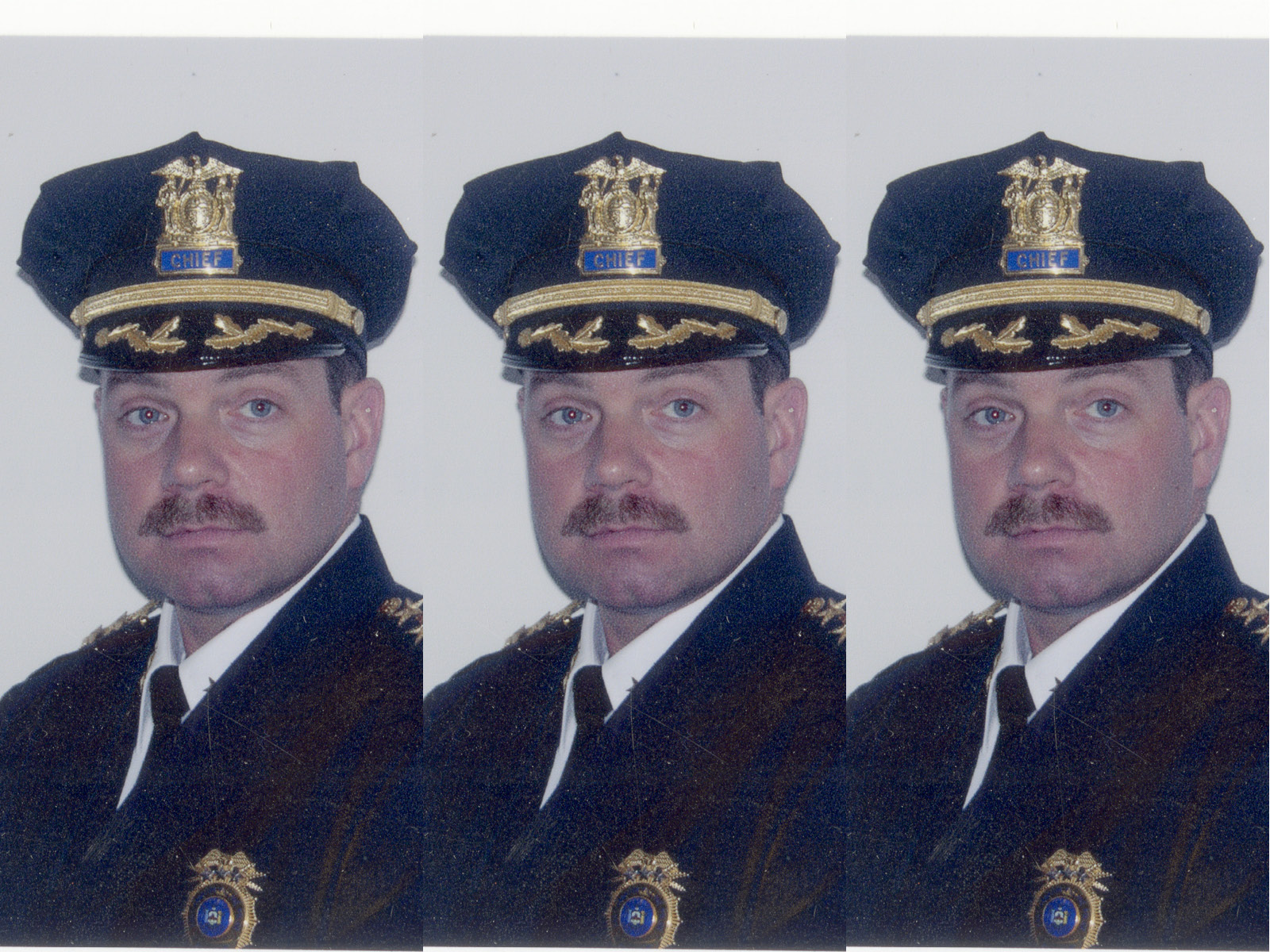
Jerry Larsen ran for East Hampton Town Board on the G.O.P. slate in 2017, announcing his candidacy two months after the East Hampton Republican Committee held a party at the American Legion Hall celebrating Donald Trump's first election. At another campaign event, Larsen posed with Lee Zeldin, the then-congressman who had previously voted against marriage equality and who, as head of the Environmental Protection Agency, went on to repeal the E.P.A.'s ability to regulate greenhouse gas emissions.
Despite a national momentum culminating in Donald Trump’s 2016 election, the town’s Republican committee failed to seat its board or supervisor candidates in 2017. Larsen pivoted to his NewTown Party to run for mayor of East Hampton Village — candidates in the village don’t run as Democrats or Republicans, using names like Elms Party or Fish Hooks Party instead — and won in 2020.
During his two terms in office, Larsen rebranded as a Democrat. He spearheaded an effort to provide mental health support for police officers shortly after the police-reform era of 2020. He supported legislation to limit plastic takeout containers. He suggested to the founder of Hamptons Pride that the nonprofit establish an annual parade. He lent his support to a code proposal by Organizacion Latino Americana of Eastern Long Island to prevent local officers from participating in federal Immigration and Customs Enforcement actions.
On June 23, Larsen will challenge incumbent Kathee Burke-Gonzalez in the Democratic primary to be that party’s candidate for supervisor, East Hampton Town’s highest elected office. Because the Republican committee will not run a candidate for supervisor this cycle, it seems a foregone conclusion that whoever wins the primary wins the election. Almost unanimously, Democratic officials have rallied around Burke-Gonzalez, the local party’s chosen candidate, who has been endorsed by New York State Assemblyman Tommy John Schiavoni and Suffolk County Legislator Ann Welker.
Regarding Jerry Larsen, the cry among Democratic standard-bearers seems to be universal: He’s not really one of us.
If Larsen does manage to win his bid for town supervisor, he estimates it will be around the 25th job he’s worked so far.
Larsen got his first gig at 12 as a newspaper boy for Newsweek, delivering papers from his bicycle seven days a week, year round. He delivered so many papers one year that the company rewarded him with a trip to an amusement park. In the summers, he worked as a dishwasher at the kitchens of the Sea Spray Inn, Loaves and Fishes, and Villa Prince Ristorante. He got a job at the old bowling alley at 14 and by senior year was doing overnight shifts at the A&P supermarket on Newtown Lane before school.
“We had no money, and I had to help my parents with the rent,” says Larsen, sitting at a circular wooden table in his mayor’s office, suddenly bashful. “Just don’t make me sound like, you know . . . I don’t want sympathy.”
The mayor is pleasantly under-media-trained, and seems retrospectively unsure about the merits of revealing personal childhood struggles. But this seeming openness is part of his appeal, and he shrugs off the concern with the self-assurance of a man who has made his own luck.
When Larsen graduated from high school in 1982, his dad fell sick and his parents moved to Mississippi, leaving the 18-year-old to support himself fully. He got a job as a traffic control officer and then as a police officer in the village. “I always wanted to be a cop,” he says. “That was the only thing I ever wanted to be in my life — I was just drawn to it.”
But Larsen says he craved constant action, and village policing in the dead of winter in the 1980s held little promise for that. “My first shift was a midnight shift. I drove around and never passed a car and got up to Georgia Beach and looked out at the ocean and said, ‘What have I done?!’ ”
Larsen picked up a succession of part-time jobs to balance his career in policing, working as a plumber, building-site cleaner, movie theater usher, bus driver, Jitney driver, oil truck driver, water delivery driver, and deli delivery driver.
“I think my work ethic came from not wanting to ever be poor again. You know? And I still have that horrible feeling today,” says Larsen. “If I’m not super-busy, I feel like I’m not making enough money. . . . It would be nice to be able to relax more.”
Even as Larsen rose in the ranks, moving from detective to sergeant to lieutenant, and then eventually to chief, a title he held for 14 years, he didn’t stop hustling. He started and sold a tire-booting company to enforce parking rules in private parking lots, and a valet parking company that employed more than 100 people. In 2005, he and his second wife, Lisa Mulhern-Larsen, formed a security company called Protec Security that sells services such as home surveillance installation and monitoring.
Hustling and civil service can mix like oil and water. As police chief, Larsen regularly butted heads with his overseers on the village board over Protec. The board saw the business as a conflict of interest: Did Larsen’s clients get priority over other village constituents? If a client got burglarized, might Larsen allocate additional village resources at his disposal to recover the property he is financially incentivised to protect? Was Larsen leveraging his position as police chief to drum up business? His personnel file, stuffed with paper documenting his contretemps with his village employers, bulged.
Larsen scoffs at all this — it’s nuance. “There can be conflicts of interests, but if you announce most things, you eliminate that.” If you disclose a financial connection, he believes, then the village board can monitor the relationship for any special treatment. He denies that Protec’s success was owing to his being police chief, and in 2017 launched an unsuccessful lawsuit — dismissed as untimely because the alleged actions occurred in 2009 — claiming that the village prohibited Protec from operating inside its bounds because it posed a competitive threat to the security business that then-mayor Paul F. Rickenbach Jr. himself had ties with.
It seems possible that this conflict marked the beginning of Larsen’s political aspirations: He nurtured a distaste for what he might characterize as overreach and others might call oversight — for red tape that serves, depending on your perspective, to keep the baying hounds of commercialism at bay or that simply keeps the pie carved up in the same shape.
A couple of years after the village board decided not to renew his contract as police chief — and after unsuccessfully running for a seat on the town board on the Republican ticket in 2017 — Larsen announced his candidacy for village mayor. The initial impulse, as he tells it, came from a fealty to his friends in the Police Department. “They were being disciplined for things that really didn’t need to elevate to that level of discipline. And it was really being directed from the board. . . . It got me interested in running for mayor.”
Larsen’s campaign slogan, “Vote For Change,” called for an end to the restrictive culture of village governance and its stringent rules, whether it was code preventing a boutique from hanging flowers from its awning or hypervigilant regulations about fencing. “It’s like it was the ‘village of no,’ ” says Larsen, quoting a phrase popular among those who felt the village had become anti-business. “Anything you want to do here? The first answer is no. ‘I want to do an event in the park.’ No. ‘We want to have a farmers market.’ No, too dangerous. ‘We want to have outdoor dining.’ No, too much liability.”
Larsen ran an aggressive absentee-ballot campaign, circulating ballots pre-filled with everything except signature and date, and won by a long shot. He garnered nearly twice as many votes as Barbara Borsack, the deputy mayor under Rickenbach and the first-ever woman to be elected to the board, and Arthur (Tiger) Graham, a third candidate and village board member who jumped in and may have split the vote.
Unsubstantiated rumors swirled during the campaign and on Election Day: Some said Jerry’s wife hovered overhead while voters filled out ballots; that police friends distributed envelopes in uniform to intimidate elderly voters; that town residents listed village business addresses as fake residences. While Larsen rolls his eyes at this gossip, he readily admits that his campaign courted second-home owners.
“I don’t think there’s anything wrong with catering, if you want to call it that, to second-home owners. That’s how I won,” says Larsen. “That’s what the [previous administration] missed — that the village is like 90 percent second-home owners.”
He recalls watching a meeting before he ran for mayor in which a seasonal resident sought permission to pave a path between his hot tub and house. “They mocked him, like, ‘Oh, wouldn’t want to get mud on my feet.’ And then one of the people even said, ‘His pool is bigger than my whole house,’ ” says Larsen. “I mean, that kind of stuff has no place — the jealousy, the envy — it has no place when you’re making decisions.”
Larsen recalls childhood summers spent playing with seasonal neighbors and teenage years working at the Sea Spray Inn alongside city kids, and feels generally fondly for the second-home owner population. “You’ve got to remember, the second-home owners pay a ton of money in taxes and they don’t draw anything from our services,” says Larsen. “Like, the biggest part of your tax bill is the school budget. They’re paying that tax burden, but they don’t have any kids in the school.”
Courting absentee voters is not a new tactic. It was part of the reason that Democrats were able to wrestle the town from Republicans, who held almost absolute control until the 1970s. When Judith Hope, a Democrat, ran for supervisor in 1973, the Republican elections commissioner called her campaign’s absentee- ballot efforts an “organized plot” in an “operation election takeover.”
East Hampton’s extreme seasonality makes it a unique political battleground, where campaigns often center around tension between year-rounders and summer people. Republicans accuse Democrats of ignoring working-class Bonackers in favor of their elite New York City supporters. Democrats accuse Republicans of allowing greedy speculators to overbuild, destroying the East End’s historic character.
In their staunch opposition to overdevelopment, East Hampton Democrats have adopted a sort of conservatism. While preservationist work often centers around protecting nature, it can also take on a NIMBY-ish edge. They aren’t purely concerned for the encroachment of humans on biodiverse systems, but alarmed over an encroachment that seems equally existential: tackiness.
With its stringent regulations on signage and agonizing deliberation over things like exterior paint colors in the historic districts, East Hampton sometimes seems singularly focused on staving off ugliness. It clutches its pearls at the intrusion of new-money clubs (like Zero Bond in 2024) and retail chains (“luxury blight,” a term this magazine coined in 2019) that push up against its historic charm and pristine natural beauty.
If you sit through a village board meeting, you might find that most issues are so nuts-and-bolts specific that their connection to abstract political allegiances would be tenuous: resolutions concerning sidewalk repairs, carpet replacements, and crosswalk enhancements. And for a century, these debates rarely took on a red-versus-blue partisan tinge. But, during Larsen’s time as mayor, cultural distinctions between the national parties seemed to trickle down to the local level. Only Democrats would say Democrats have better taste than Republicans (pointing out that MAGA does seem to relish a particularly gaudy, gold-plated look); Republicans might insist the reverse (painting Democrats as killjoys with an aversion to “common” taste, who built sterile Brutalist buildings in the name of progress). Here, as in Washington, evaluations of candidates sometimes get so wrapped up in matters of image and personality that policy recedes into the background.
And so it’s difficult not to wonder if part of the reason that some Democrats find Larsen so utterly unappealing comes down to aesthetic sensibility. His administration has, indeed, taken some questionable creative liberties: It plopped a giant, mirrored bull — an eyesore of an art installation — in Herrick Park. It replaced older forest-green metal trash cans with chunky, black 1980s-looking ones. In a village where excess commercial signage used to be anathema, it started hanging plastic banners from the lampposts to promote events. It made a whole thing of Christmas, installing outdoor speakers to play holiday tunes and flying in Santa by helicopter. It hosted an art fair at Village Hall showcasing work that mostly looked plucked from the underbelly of Etsy. An ex-cop with a teenage bowling record, detractors seem to suggest, can’t be trusted with the aesthetic guardianship of a world-renowned resort town.
“Idon’t think that national politics has any place in town and village elections,” says Larsen. “We should be uniting people. . . . There’s things we all want. We all want a good job, we all want health insurance. We all want safety, right? Those are the things that affect us in our town.”
Larsen wants to cut through the Washington noise with “common sense” politics, an ideologically neutral, administrative aptitude. He wants to do things like develop empty lots, build affordable housing for young families, fix roads, and stabilize staffing. He wants to bring the rich second-home owners and locals together with events like the ones he runs in the village, with block parties on Newtown Lane and Tuesday night concerts at Main Beach.
There’s a genuine pragmatism to Larsen’s approach to local politics; at its best, it feels disentangled from abstract party loyalty, allowing him to take seriously the specific concerns of a small town and to respond to requests from its citizenry. Larsen’s supporters often talk about his willingness to really listen to their concerns. It’s no small thing to feel heard by your representatives, and analysts often cite it as the reason that the Democratic establishment lost control of Washington. In Larsen, supporters find a force of personality who fought tooth and nail to rise from inauspicious beginnings to prominence in a place mercilessly defined by class, a well-positioned ally who can empathize with adversity.
So if Larsen needs to run as a Democrat in a town that votes two-to-one with the party to achieve a common-sense agenda, why not? Is the label even significant on a local level?
The problem Larsen faces in leaping across political boundaries is that party affiliation in East Hampton runs deeper than aesthetic pretension or social-class identification — it cannot be brushed aside by denouncements of national drama or support for pride parades. Even in a town that has become as demographically complex and seasonal as East Hampton, the fundamental difference between Democrats and Republicans still lies in beliefs about the role of government and how big it should be.
Larsen has time and again demonstrated a desire for smaller government. He ran for mayor, in his account, so that his friends on the force would face fewer punitive measures and so that he could reduce the red tape on businesses that resulted in the “village of no.” As mayor, he cut taxes for three consecutive years in the village. He disbanded the committee that previously vetted zoning code changes and loosened restrictions regulating what property owners can build on their lots.
Perhaps the most illustrative of Larsen’s spin on small government is the East Hampton Village Foundation, which he launched in 2021 with Bradford Billet, a philanthropist and former staffer for New York City Mayor Rudy Giuliani. The foundation has raised more than $3.5 million over the past four years to finance projects like the Herrick Park renovations, Santafest, and the Main Beach concert series. It is a mechanism, imported by Billet from the city, to offload costs from taxpayers onto the shoulders of private donors.
“What the foundation allows me to do is get things done quicker than I would normally be able to do,” says Larsen. “Getting money for the park, for example. I didn’t have to bond for it and then go to referendum.” The village, in other words, did not have to hold a public vote about taking on debt to fund the project. Instead, the vote for whether or not to accept the foundation’s donation went through a more insular — less public — process within the board of trustees. While the donation allowed the administration to avoid debt, as well as the agonizing deliberations endured during the previous administration, critics point to the Herrick project as an example of public decisions playing out too quickly, too privately, and too much at Larsen’s discretion.
With the infusion of funds, the foundation has helped Larsen implement his “common-sense” agenda in the village, but has also illustrated the falsity of packaging common-sense politics as ideologically neutral. In 2024, the foundation donated $60,000 to the village to purchase 10 Flock Safety license-plate readers. The cameras work by capturing a vehicle’s license plate and details including make and model, and then automatically cross-referencing that information across law enforcement databases. The cameras are remarkably effective: Reporting from The East Hampton Star found that over a one-week period last spring, the cameras were responsible for 10 out of 12 arrests. The Flocks help catch criminals and don’t cost taxpayers a thing. A triumph of common sense, yes?
But installing 10 (14 when you count the four donated by Suffolk County) cameras to monitor the five square miles of East Hampton Village is motivated by an implicit ideology, one that takes for granted the merits of extending law enforcement’s reach. East Hampton Village has a very low crime rate, significantly below the national average for violent and property crimes. During the week that The Star covered, all 10 Flock-facilitated arrests were due to suspended car registrations, nine of which were suspended for failure to keep up with insurance payments. In the village, the cameras seem to primarily punish crimes of poverty.
The administration maintains it will not use the cameras for federal civil immigration enforcement, yet Flock’s cameras connect to broader networks outside of village jurisdiction. The village can’t control how this data is used.
Although Larsen says that the village would have eventually budgeted money to buy the cameras with or without the donation from the East Hampton Village Foundation, the idea for the cameras came from Edward Pantzer, a foundation board member with a house in Palm Beach, Fla., another ultrawealthy resort town whose Flock cameras monitor an area whose working underclass perhaps feels a little too close for comfort.
While the funds from the foundation have allowed Larsen to get a lot done quickly, they have also raised questions similar to the ones he fielded from the board when running Protec as police chief: Does Larsen award contracts to friends and allies? What about political donors? And although he vehemently rejects gossip that he does things like give out special license plates or staff’s personal cellphone numbers to foundation donors, the fact that the foundation maintains strict donor anonymity has invited suspicion about the danger of regulatory favors, like zoning easements, being doled out. Democratic government is supposed to check a representative’s ability to exercise power contrary to public interest, and shrinking it can diminish that check.
Some detractors who spoke on the condition of anonymity told East that Larsen wields government not just to reward his loyalists, but also to punish his enemies. And one of his most vocal critics at board meetings, David Ganz, is currently pursuing litigation against Larsen for what he characterizes as vindictive behavior.
On June 6, 2024, The Star published Ganz’s latest critical letter to the editor; in this one, he vividly drew comparisons between Larsen’s administration and the pigs in George Orwell’s Animal Farm. On or around June 7, the village revoked Ganz’s rental locker at Main Beach (a coveted prize with a long waitlist). Larsen denies any correlation between the two events, but Ganz sued. The village, in response, said that the permit was revoked as a result of Ganz’s “dangerous and reckless driving” in the parking lot at the Main Beach pavilion. It turned into a whole palaver, with FOIL requests, sworn affidavits, and unsubstantiated claims that video footage had been inadvertently taped over. Ganz’s lawyer, however, was able to obtain a copy of the video from the District Attorney’s office; East also obtained a copy of the video. While it is outside of the scope of this article to comment on the quality of Ganz’s driving, we can note that his car was moving so slowly that it was outpaced by someone calmly peddling a bicycle. In the end, a judge decided that the village administrator did not have the authority to revoke Ganz’s Main Beach locker, calling the move “arbitrary and capricious.”
Ever since developers started parceling out estates in the 1960s, the choice between big and small government has been of central importance in East Hampton. And, since the 1970s, residents — by voting the Democratic Party line — have affirmed their preference for a bigger government that maintains at least some control over development and pushes back against corporate interests.
Larsen’s supporters often speak about how — from construction to real estate jobs — the town runs on the building industry. But as superficial as aesthetic anxieties can seem, and as wrapped up in class loyalty as they often are, the town’s economic future depends on its staying beautiful. If development keeps pace or accelerates, the place will lose status and the bubble will burst anyway. Larsen wants to reinvigorate the town, but slapping block parties and Santa visits on top of a deregulated market may be like putting a Band-aid on a cancerous lesion.
Change itself is not bad; it’s inevitable and nature’s only constant. But when it’s fueled primarily by financial incentives, a blindness toward other types of value sets in. Remaining pockets of older human and nonhuman ecosystems are valuable in their own right. It is in the town’s best interest to protect them, for their own sake, from the unquenchable machinery of capital growth. We don’t need to guess what cultural destitution sits at the end of the road for an artists sanctuary turned into a speculative real estate market —we’ve already arrived.
Former Supervisor Larry Cantwell, who is supporting Larsen’s opponent, worked in East Hampton Town and Village government for 42 years and considers conservation an existential effort. “During my time serving the community there were tremendous pressures to develop. We promoted strict zoning laws to regulate development. Without that, the area would’ve been overrun,” he says. “Some people say we were the town or village of no. And yet I’m here at the age of 75 saying I wish we said ‘no’ more often.”