
Paradise Lost
It’s hard to imagine, but what started in 1985 as an attempt to save a handful of modernist gems turned into a much broader mission: the discovery, documentation, and preservation of a lost culture, one that was gradually being written out of history. The new edition of Weekend Utopia: A Century of Modern Living in the Hamptons by Alastair Gordon marks the 25th anniversary of the original 2001 publication with updated and expanded text and previously unpublished images. While the original edition covered a 50-year period — from 1925 to 1975 — the new one brings the story up to the present day, spanning a century of modern living in the Hamptons.
FORBIDDEN FUTURES
Beginning in 1985, I went on a rather manic quest to uncover lost artifacts of the 20th century — the forgotten modernist architecture of eastern Long Island. It seemed quite mad at the time. I’d just moved back from L.A., where I’d immersed myself in the early buildings of Richard Neutra, Rudolph Schindler, and Charles and Ray Eames. By the mid-1980s, their lighter-than-air vision of American utopia was being supplanted by a much more conservative materialism. Modernism had grown stale and had a bad name. It was considered cold and clinical. Neotraditional forms of architecture were all the rage.
Inspired by my own family’s beach house in Amagansett, the original edition of Weekend Utopia (2001) was based largely on the groundwork I’d done for a series of articles in The East Hampton Star and The New York Times, as well as two exhibitions I curated at Guild Hall — one in 1987, the other in 1999. I became obsessed with the subject and spent years searching in archives and snooping through hedgerows. I had developed nostalgia for a utopian future that would never come to pass.
At first, my list was short, only about a dozen examples — but it soon grew to more than 50, including prototypes by pioneers like William Muschenheim, Pierre Chareau, Peter Blake, Andrew Geller, and Julian and Barbara Neski, some of whom had been nearly forgotten. I began to understand why the East End had become so fertile a breeding ground for experimental design, at least as fertile as Palm Springs, Sarasota, or New Canaan — the big difference being that architectural innovation on the South Fork was inspired as much by the avant-garde art that was being produced in the same place, at the same time. As the art critic Harold Rosenberg said: “The new painting has broken down every distinction between art and life.”
The history of the modern beach house presented a uniquely utopian promise to a postwar generation who survived World War II and yearned for a more open and intimate connection to nature. The notion of modernity was centered on the self, physical health, aesthetic refinement (doing more with less), and the idea of a radiant future that combined the best of the city (power and cultural sophistication) with the best of the country (nature and peace).
In 1963 to ’64 my own parents built a small, modern beach house on a waterfront site in Amagansett that had a profound impact on our lives. It was both an emotional embodiment of our dreams, as well as a means of self-discovery, a kind of personal happening, much like the music and subculture of the 1960s. The beach house was Lilliputian, less than 1,200 square feet with an outdoor shower, open-plan living area, and floor-to-ceiling glass on three sides. My own bedroom measured about 10 by 12 feet, with the kind of double-decker bunk beds that every summer house had in those days. We learned to adapt to the small confines, to live efficiently and neatly, as if on board a boat. On rainy days the spatial intimacy made everyone slightly insane — crouched around the coffee table playing Chinese checkers — but on crystal-clear summer days, interior spaces stretched to the horizon and there was no sense of separation from the dune grass, bayberry, sunlight, and salt water. It was the smallness and simplicity of this summer retreat that forced us to experience the beach firsthand — one on one — to learn tolerance and become closer knit as a family. These were the true rewards.
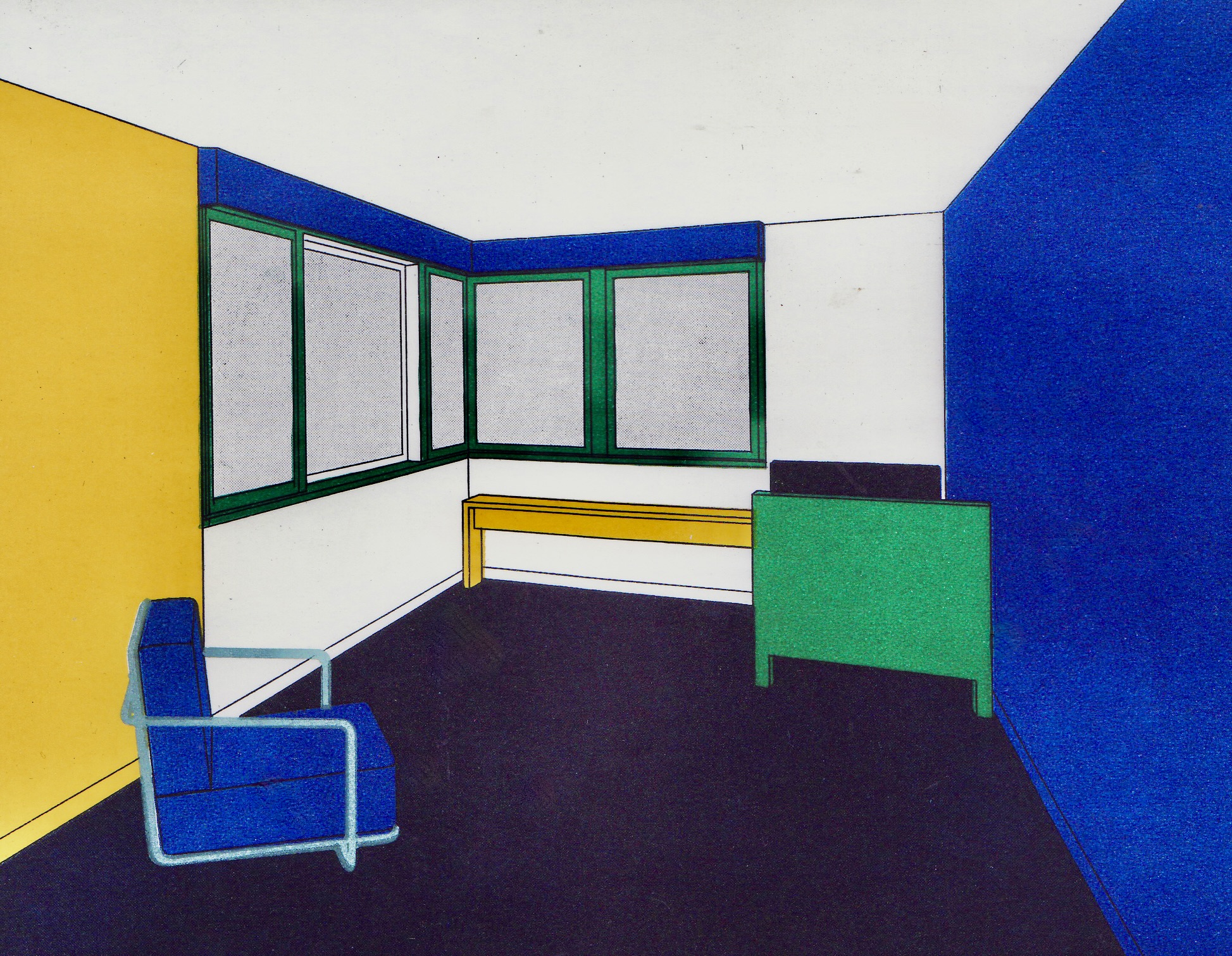
The earliest design pioneers on Long Island had either studied in Europe or were European by birth and emigrated to the U.S. “I object to uselessness. I object to cornices, to pitched roofs, to leaded glass windows, and to shutters,” wrote Percival Goodman in 1931, after being exposed to projects by Le Corbusier and Mallet-Stevens in Paris, and the radical social housing of the Weissenhof Siedlung in Stuttgart. Upon his return, Goodman proposed a modernist housing complex on Long Island, a kind of American Siedlung, with flat roofs and cantilevered decks. (It was sabotaged by local contractors and only one unit was ever built.) William Muschenheim came back from Vienna in 1929, bedazzled by the crystalline structures he’d seen by Max Taut and Walter Gropius. For his father, Muschenheim designed an oceanfront house in Hampton Bays (1930) with polychromed interiors in bold hues of yellow, blue, and green. Two years later, he added a cluster of angular bath houses that were at least 40 years ahead of their time. Frances Breese Miller, a Southampton debutante turned artist and proto-feminist, went to Sweden in 1930 and came back inspired by the glass pavilions of Erik Gunnar Asplund. She built her own flat-roofed beach house in Bridgehampton — the ultramodern “Sandbox” that served as a manifesto for her own liberation. “Tradition has been abandoned,” she wrote. “No covered porches, no dining room . . . no maid’s room!”
While the first wave of experimentation may have originated in the socialist cultures of Holland, Sweden, and Weimar Germany, it took on a very different narrative when pressed into the service of American-style leisure. In fact, the Neue Sachlichkeit spirit wouldn’t fully catch on in the Hamptons until after World War II, when a younger generation of artists and architects came out to celebrate the sea-flecked light and low-lying landscape of sandy meadows, bayberry, and pitch pine — what John Hall Wheelock described as the “bird-haunted, ocean-haunted-land of youth . . . and desired return.”
CONVERGENCE
Some of the young architects who came to the South Fork in the postwar period believed that painters like Pollock and de Kooning were leading the way toward a new sensibility that they were morally obliged to follow. Peter Blake, the German-born architect, critic, and curator, wrote: “What I and others saw in the new painting in New York and in the Hamptons was only the beginning; we were sure that a similar architectural energy would soon manifest itself all around us. And we felt we were ready.”
Some of the experimental houses of this period were conceived on the border between abstract sculpture and architecture. Working from a small studio in Springs, Frederick Kiesler made literal attempts to create a free-flowing continuity — not unlike Pollock’s drip canvases — in his Endless House project. The architect/sculptor Tony Smith worked with crystalline networks to create a new kind of dwelling. Peter Blake confessed to an almost mystical sense of awe upon first visiting Pollock’s studio in 1949: “I’d heard a little about him but never seen any of his work, and it was — well, the sun was shining when I walked into his studio, shining in and into the paintings. It was like walking into the Hall of Mirrors at Versailles — dazzling, incredible!” His friendship with Pollock led to a collaboration between artist and architect on an “Ideal Museum” in which Pollock’s painting would hang as free-floating panels in an all-glass pavilion. Blake’s architecture would be an interpretation and extension of Pollock’s art. Inside and outside, foreground and background, would be seamlessly merged. A scale model of the Ideal Museum was included in an exhibition of Pollock’s work at the Betty Parsons Gallery in New York City in 1949. In a more perfect world, the slab-like pavilion would have been built behind Pollock’s own house, overlooking Accabonac Harbor, but it was never fully realized.
A few miles from Pollock’s studio, another painter, Robert Motherwell, asked a French émigré friend, Pierre Chareau, to design a house and studio on a four-acre site in East Hampton. Chareau was best known for the Maison de Verre, a revolutionary house he completed in Paris in 1932. As part of their agreement, Motherwell would allow Chareau to build himself a small cottage at the back of the property. The main house for Motherwell was raw and rudimentary, designed out of necessity and readily available materials, namely a war surplus Quonset hut with corrugated metal walls. Chareau drew the most rudimentary floor plan on a scrap of paper and proceeded to improvise. When finished, it was a most eccentric and ungainly looking hybrid, a subversion of the standard American house and the last thing you’d expect to find in the estate section of East Hampton. To the conservative summer colony in 1946, the house seemed scandalous, a purposeful provocation. In fact, the house can be seen as an extension of Motherwell’s collage work from this period. The ad hoc spirit of the architecture possessed similar qualities to the Cubistic layering in Motherwell’s own art, especially the rough oak floors, corrugated roof and exposed structural elements that Motherwell painted a bright circus-red.
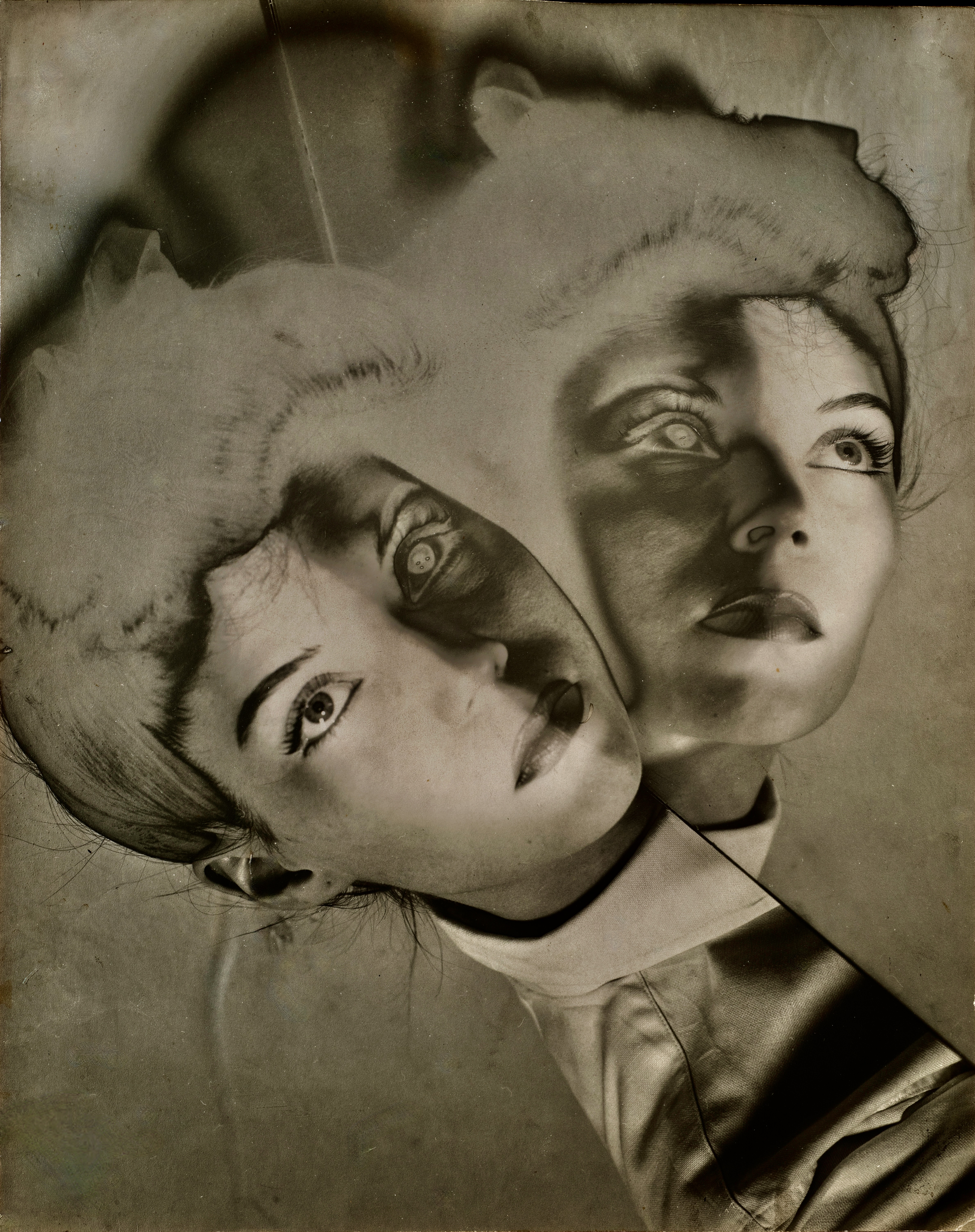
While the story of the compound is remembered as a collaboration between two famous men, there was a third collaborator who hardly ever gets mentioned: Maria Emilia Ferreira y Moyers, Motherwell’s first wife. Mexican by birth, Maria was dark and beautiful with jet-black hair and statuesque figure. She frequently posed for photographers like Erwin Blumenfeld, who used her as a model in a series of solarized photographs that show her face broken up into angular fragments. But she was also an artist and performer in her own right, and made many contributions to the layout of the Quonset house. Robert and Maria got divorced in 1949. Motherwell sold the East Hampton property to Barney Rosset in 1950 and moved to Provincetown. (He would remarry three more times.) Chareau died in 1950 and was buried in Most Holy Trinity Cemetery on Cedar Street, East Hampton. Maria moved to Monterey, California, and slipped into obscurity. Motherwell died in 1991.
UTOPIA LOST
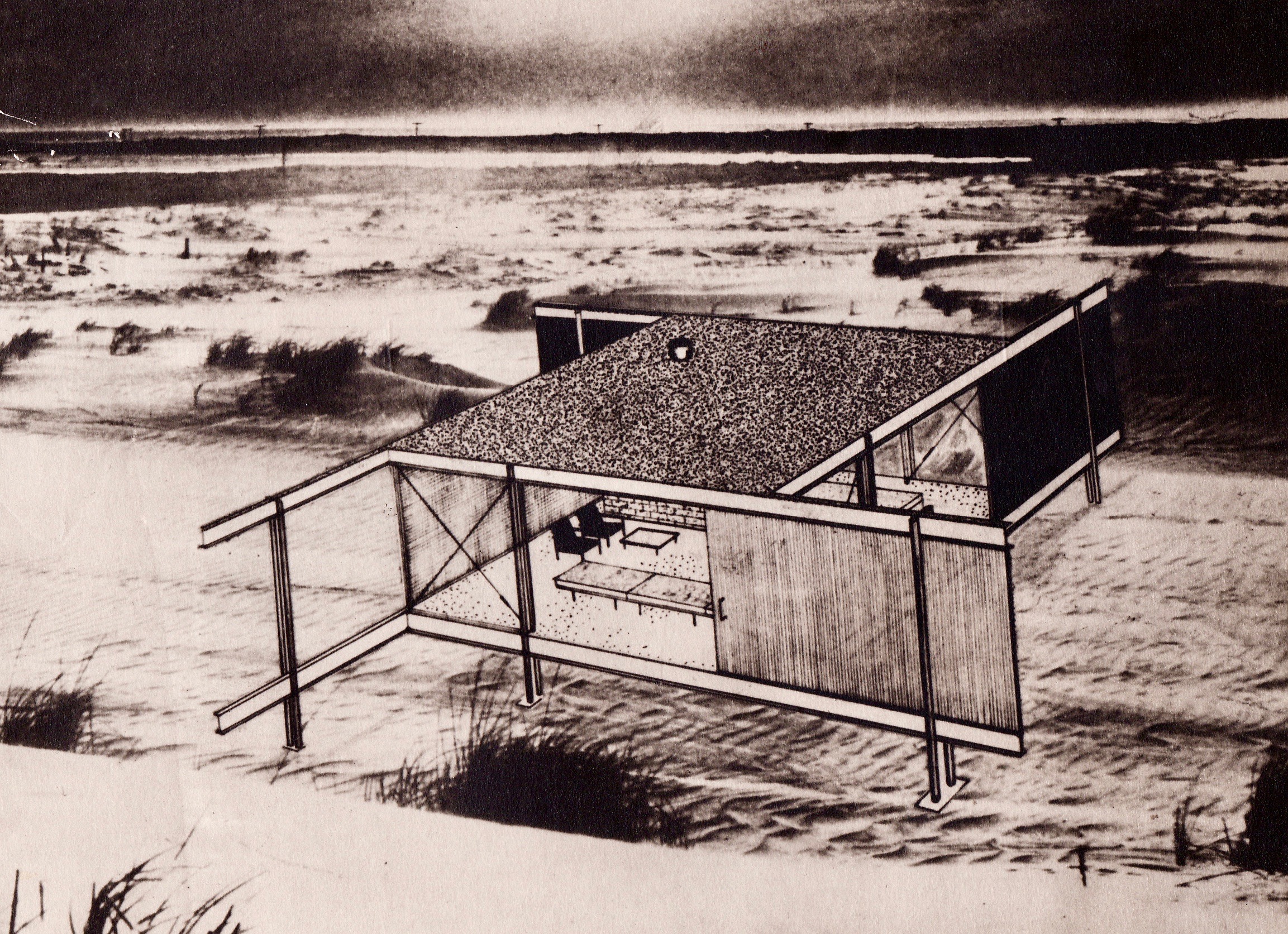
Since Weekend Utopia was first published in 2001, more than two dozen of the projects featured in the book have been either demolished or remodeled beyond recognition, while the fate of several others remains precariously in the balance. It started in the summer of 1985, when the iconic Motherwell house was unceremoniously demolished to make way for an Adirondack-style “cottage.” Battle lines were drawn. While a concerted effort was made to save the house, the new owners went ahead and leveled it — and not just the house, but also the Motherwell studio as well as Pierre Chareau’s tiny concrete cabanon that sat near the back of the property. All three structures were bulldozed into oblivion and carted off to some ignominious landfill near Yaphank. Here was an experimental collaboration by two demigods of 20th-century modernism: Motherwell, one of the most important painters of the postwar period, and Chareau, designer of the legendary Maison de Verre, godfather of industrial chic. If a building of such exalted provenance could be lost, how was one expected to save a building of lesser import?
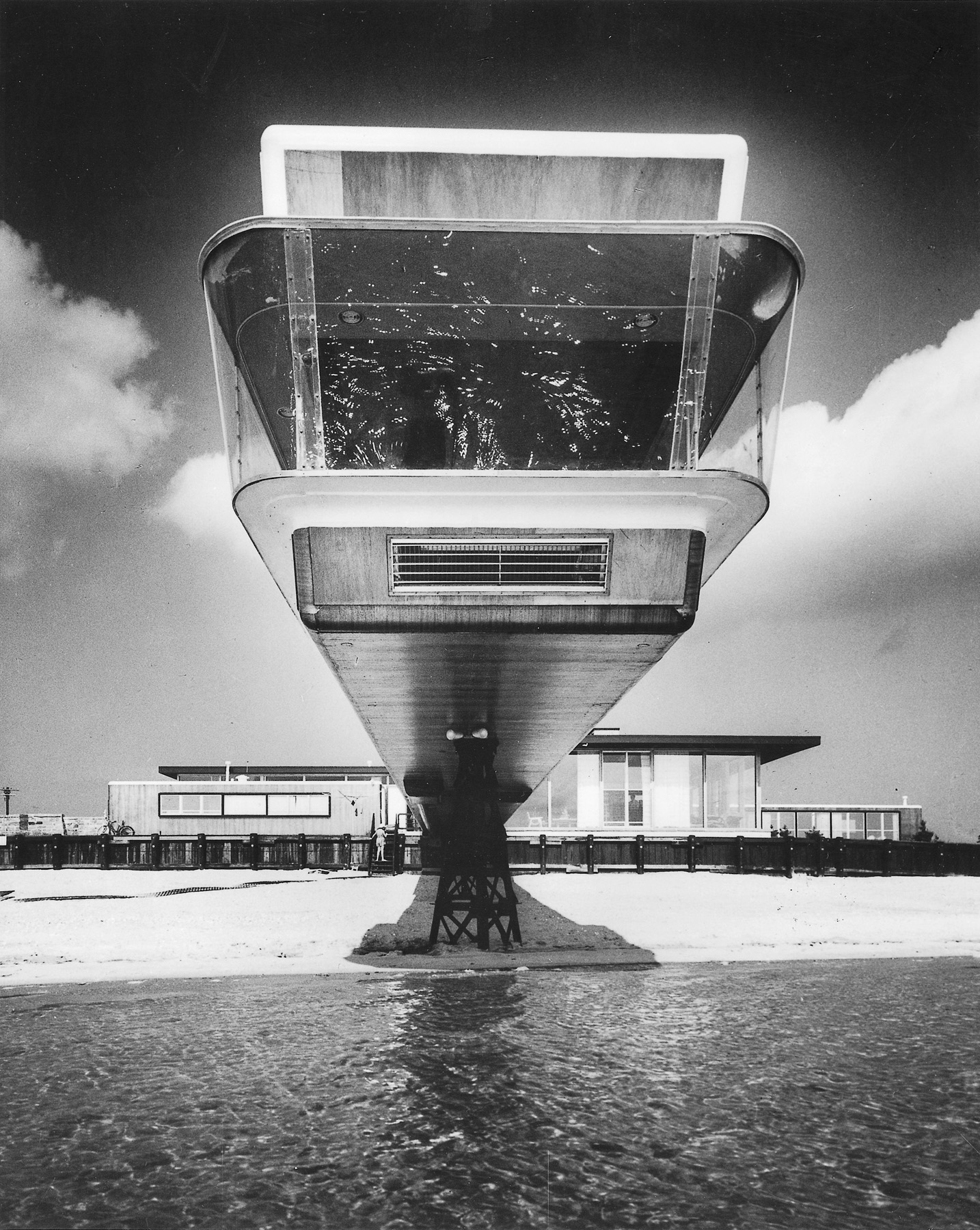
Throughout the 1980s and 1990s, prices continued to surge for Hamptons properties — especially waterfront lots — on which many of the postwar experiments had been built, making the preservation of these small, seasonal structures especially challenging. If a hedge fund manager paid $30 million for an oceanfront lot, why should he/she be expected to settle for an 800-square-foot cube, no bigger than a shack? It was an improbable argument.
WASPy fashion models, South American polo players, and blue-eyed debutantes dominated the pages of Vogue and Vanity Fair, while a new wave of well-heeled arrivistes dressed like English gentry in Ralph Lauren jodhpurs and silk cravats. “We are just exceedingly conservative out here,” said one realtor. “Younger buyers are trying to look as if their families got off the train in 1870.” They certainly didn’t want glassy, flat-roofed pavilions. The ultrarich wanted formal gardens, thick privet hedges, and gravel driveways that crunched perfectly underfoot. They wanted homes that conveyed power, membership in the tribe, and a neatly fossilized version of history. A postmodern style of choice was appropriated from the late 19th century, a bloated robber-baron architecture modified for contemporary living with larger (often faux) Palladian windows, state-of-the-art communication networks, computerized irrigation systems, voice-activated portals, and robotic pool cleaners.
This hyped-up version of the Shingle Style reflected the acquisitive instincts of wannabe billionaires who came east not to relax or seek oneness with nature, but for manic networking and one-upmanship. It was a grab bag of quaint dormers, bays, oriels, peaked roofs, wraparound verandas, Gatsby-style lawns, boxwood borders, pergolas, and other Victorian doodads that were meant to signal old money but did just the opposite. In fact, it was little more than cabin porn for the one percent. One conspicuous example was the 110,000-square-foot Fair Field, fittingly dubbed in the press as the “House That Ate the Hamptons.” This limestone behemoth sprawled across its 83-acre site with pseudo-classical pomposity, boasting 29 bedrooms, 39 bathrooms, 11 sitting rooms, three swimming pools, two bowling alleys, a pair of squash courts, a 20-car garage, screening room, seven outbuildings, endless vaulted galleries, and enough Palladian windows to make an Eastern European dictator sick with envy.
After the destruction of the Motherwell compound in 1985 came a procession of equally frustrating losses. Some went with hardly a whisper of dissent. A few became front-page news. The Muschenheim house and bathing cabanas went in the late 1980s, as did Frances Miller’s Sandbox and three of George Nelson’s lighter-than-air summer follies, all lost in rapid succession. Where there were a few success stories, the reality is that without money, lawyers, patience, perseverance, sympathetic zoning, and/or a willing benefactor, the odds weighed heavily against preservation. Philip Johnson’s Farney House (Sagaponack, 1946) was torn down in 2014, as was Robert Rosenberg’s all-glass pavilion built in 1952 on a dune overlooking Two Mile Hollow. Other losses included both of Charles Gwathmey’s Steele Houses (Bridgehampton, 1971), as well as several important residences by Norman Jaffe. The most tabloid-worthy saga, however, was Gordon Bunshaft’s elegant travertine house as it was cannibalized by Martha Stewart and demolished by Donald Maharam, the subsequent owner.
The ongoing assault on experimental design has continued well into the 21st century. A recent loss was the 2023 annihilation of the celebrated Spaeth House by George Nelson and Gordon Chadwick (East Hampton, 1955), arguably one of the most significant houses in the Hamptons. As of this writing, the fate of Norman Jaffe’s Bliss House (1978) still hangs in the balance.
REVISION
At least there’s more awareness of the importance of early modern structures, however small and ephemeral they may be. Groups like Preservation Long Island, Hamptons 20 Century Modern, and East Hampton’s Village Preservation Society have tried to educate and advocate for the rescue of endangered midcentury structures. It’s still a long shot, but the news isn’t all bad. There have been several encouraging examples of early modern houses being rescued and restored by sympathetic owners, despite rising property values and a general craving for larger homes. The former Scull House (East Hampton, 1962) by Paul Lester Wiener was lovingly restored by Lisa Perry. With its flat roof, Zen courtyard, and clerestory windows, it conveys a sense of translucent weightlessness, like a paper lantern. Now called Onna House, it’s become a center for women artists. Keeping it in the family for a third generation, Norman Jaffe’s Goldman House (Bridgehampton, 1970) has been meticulously restored by Asher Israelow, a young architect and grandson of the original owner. In a few cases, the architects of record have been given the chance to revise their own creations. In 2001, Charles Gwathmey remodeled the famous house he designed for his parents in Amagansett and made it his own. Ward Bennett revisited the Barragán-inspired house he’d designed for Hale Allen in the early 1960s and made it warmer and more user-friendly for Jane and Jann Wenner.
While a few of Andrew Geller’s quixotic beach houses of the 1950s and 1960s have been lost, the quirky originality of his work has elevated Geller’s name and stature, and homeowners seem less inclined to call in the bulldozers. His Antler House (Springs, 1968) was neatly restored and updated by Two Street Studio in 2019 and is undergoing yet another restoration by Andrew Pollock, an architect who also restored and expanded Julian and Barbara Neski’s Cates House (1970), a horizontal white pavilion — à la early Le Corbusier — perched atop a bluff overlooking Gardiner’s Bay. But how to preserve the original slab-like structure in its purest form while doubling the available living space? Pollock, who grew up summering on the East End, achieved a remarkable degree of clarity with a multipartite plan that featured a new guest wing — in a similarly pale Corbusian style — connected to the 1970 house by an all-glass breezeway, hardly noticeable, allowing the original pavilion to stand free and retain its full architectural integrity.
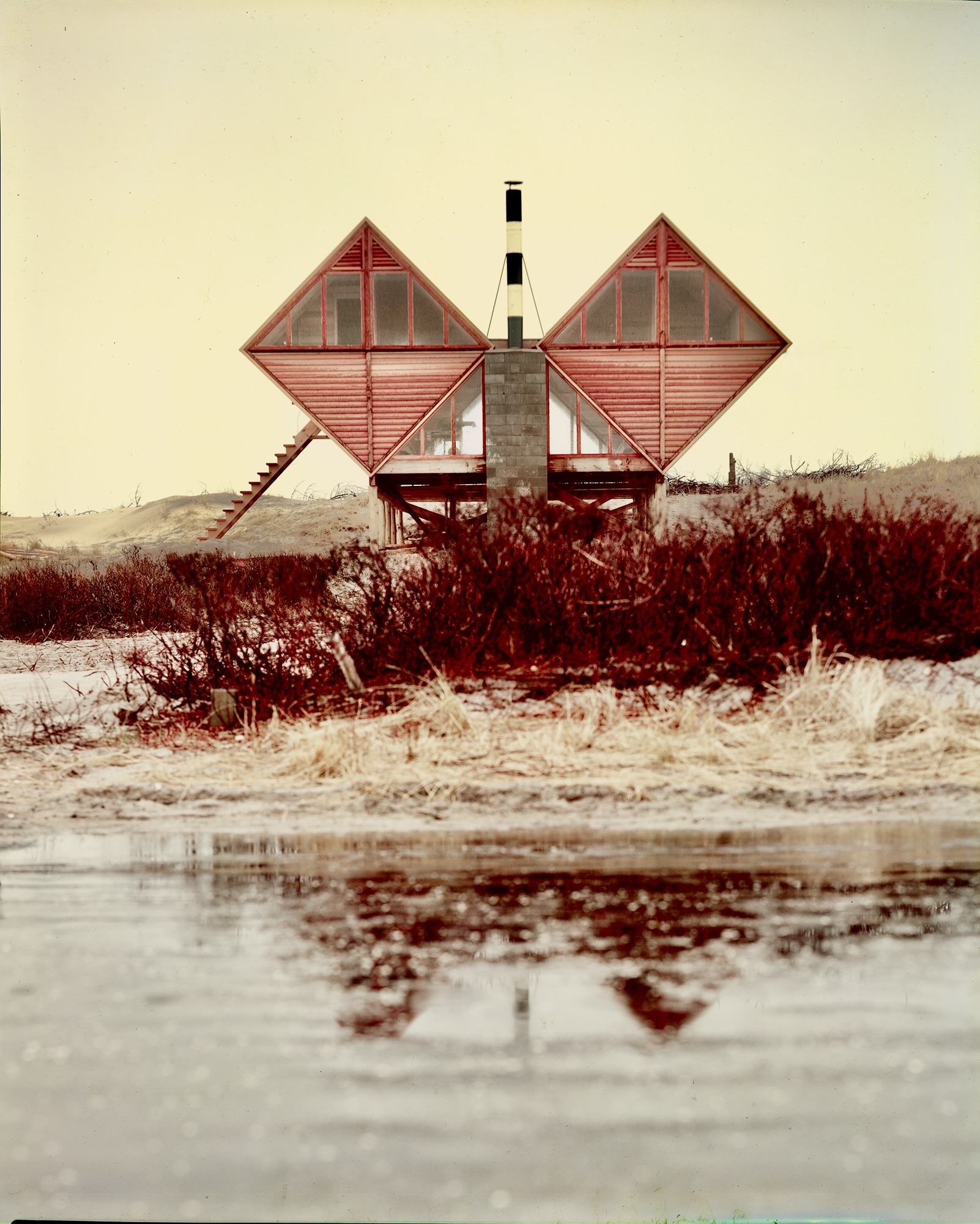
The most impressive rescue has to be the last-minute save of Geller’s iconic Pearlroth House — aka “Double Diamond” or “Square Brassiere” — the 600-square-foot delight that hovered above the dunes of Westhampton Beach. While doing research for the Long Island Modern exhibition at Guild Hall in 1987, I visited Geller at his home in Northport. His wife, Shirley, met me at the door, and said, “Come in, Andy’s been waiting for you for 30 years.” I laughed and followed her into a living room crammed with architectural models, drawings, and paintings. Every nook and cranny of the Victorian-era house held surprises, and as we sat for tea, Andy showed me an array of projects, each one more fanciful than the last. I was utterly perplexed that this man’s work was hardly known at all, but of all the documentation he showed me that day, the most memorable was a photo by Jerry Birnbaum of Pearlroth. I’d never seen anything like it and wondered how anyone could live inside such a convoluted abstraction. With its striped chimney rising between two diamond-shaped sections, the house seemed almost extraterrestrial, so radical, so modern and of the moment. I immediately detected a special kind of poetic genius and knew that Geller’s work would become a centerpiece of the upcoming exhibition at Guild Hall.
Flash forward 30 years: Desperately in need of repair, the house was saved from almost certain extinction through the combined efforts of Jake Gorst, Geller’s grandson, and Jonathan Pearlroth, son of the original owner. The 600-square-foot double diamond was moved 40 feet inland and took on new life as a pool house/guesthouse, perched behind a larger house that would take its place on the primary dune. Everything that could be salvaged from the original was incorporated into the restoration. Fresh cedar siding replaced rotten boards, and a new copper roof was added. The restoration process began in 2013 and was completed in 2015, a triumph of patience and perseverance.
THE ANTI-MCMANSION
New ideas were floating to the surface. How does one escape the spotlight but remain at the center of the Manhattan–Hamptons power axis? How does one slow down but remain in the race? By the early 1990s, fresh interpretations of modernity began to work their way into the Hamptons zeitgeist. Slow House (1991), for example, was a Deleuzian response to the idea of weekend utopia, an experiment that may have seemed absurd in the moment but inspired others to take risks. Elizabeth Diller and Ricardo Scofidio were commissioned by a Japanese entrepreneur to build an escape pod at North Haven Point. The client was an art collector who planned to pay for the project with the sale of two Cy Twombly drawings. Despite its name, Slow House was more like a slug on Benzedrine. It began with a series of theory-driven renderings and models — artworks in their own right — that splayed outward in a spiraling arc while expanding laterally and rising to their full height at the edge of a 60-foot-high bluff. Built-in video cameras recorded the water-flecked light of Peconic Bay and projected onto a screen that otherwise interrupted the actual view. The client failed to sell his Twomblys and Slow House was never completed, but it challenged the vacation-house paradigm and foreshadowed the escape velocity of 21st-century living.
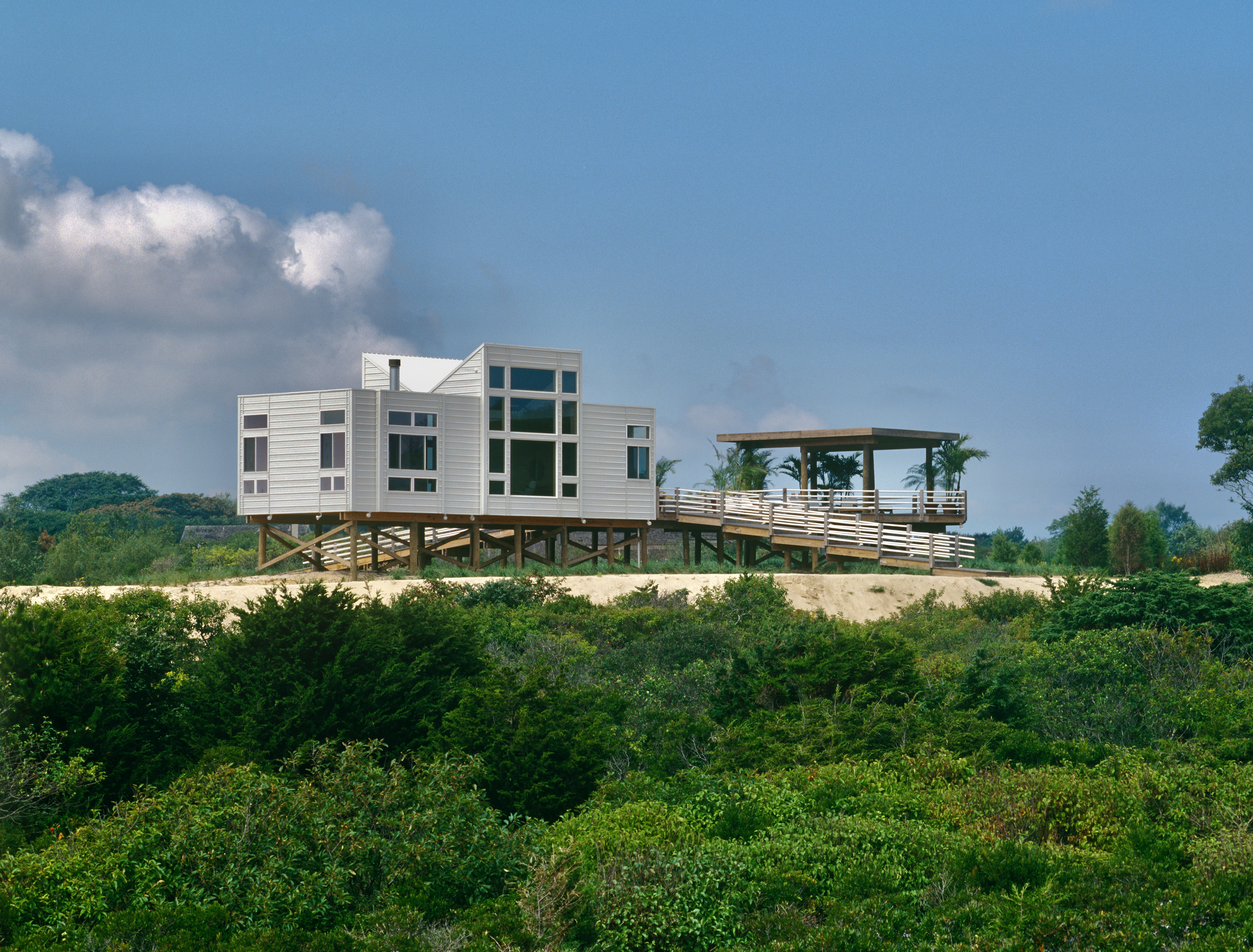
The first edition of Weekend Utopia came out in the spring of 2001 and offered an alternative history to the more conventional Hamptons narrative. The general response was encouraging. Late that summer, I sensed something percolating, and felt confident enough to publish a long-winded ramble in The New York Times about how attitudes on the East End were changing. “There is evidence of a mood shift,” I wrote. “[Several] houses finished in the last few months suggest a new spirit of restraint. They are part of a gathering anti-McMansion movement, antidotes to the architectural Viagra of recent years. All are under 2,000 square feet, and relatively affordable.” I included several examples, but the one that generated the most heat was Butterfly House, a tiny but elegantly appointed beach shack by Preston T. Phillips for a site overlooking Two Mile Hollow Beach in East Hampton Village. Propped high on wood pylons with a wraparound sundeck and outdoor shower, the house was only 1,000 square feet in size, a dreamlike throwback to the tiny, modern beach houses of the postwar period. Even more amazing was the fact that it was built for the sum of $150,000, less than what some Hamptonites spend on Époisses de Bourgogne cheese. It couldn’t have been simpler — a one-bedroom beach house with winglike roofs — sonnet to sun and sea. In reality, it was a temporary folly that would eventually be torn down to make way for a much bigger house. All the same, it struck a chord and would be featured in countless magazines around the world. This was the beginning of something. Less is more. Small is good.
Meanwhile, a parallel experiment was being launched in Sagaponack, north of the highway. The so-called Houses at Sagaponac [sic] — dubbed “Sagatopia” — were the brainchild of developer Harry “Coco” Brown, who invited 37 architects to design one-of-a-kind residences on a looping cul-de-sac. The list included such international luminaries as Richard Rogers, Philip Johnson, Zaha Hadid, Steven Holl, and Shigeru Ban. It would be the model for a new kind of modernist subdivision with small, energy-efficient structures integrated into the wooded surroundings, a moral rebuke to the ego statements that had been filling up the dunes and potato fields nearby. It would be an outdoor architecture museum, something like the Weissenhof Siedlung in Stuttgart, Germany (1927), where modernists like Le Corbusier and Ludwig Mies van der Rohe designed housing in a unified language of flat roofs and prefabricated components. Unlike Weissenhof, which was a prototype for workers’ housing, the units at Sagatopia were designed for affluent urban exiles who sought respite from their high-stress weekdays by jogging down shady lanes and attending cocktail parties. Either way, the Hamptons were not ready for any kind of progressive housing — whether for a factory worker or a social climber — and from the beginning, sales were sluggish. Only eight of the houses were ever completed.
Five days after my article appeared in The Times, the Twin Towers were attacked, and all the capricious concerns of the pre-9/11 era were forgotten. The aftermath left a cloud of uncertainty over any kind of speculation. Coco Brown died in 2005 and would never see his utopian hamlet come to fruition. The tiny-house movement didn’t catch on, and sprawling McMansions continued to be built. Maybe the Hamptons weren’t ready for a modernist makeover, after all.
ESCAPE
In more recent years, a jacked version of modernism has taken hold. The once-radical precepts of the modern movement have been stripped of all social idealism and become just another marker of taste, a style for one percenters who want to express their arrival through a sleeker, more sophisticated kind of architecture. The breezy joys of summer leisure are no longer the point. The new type of flat-roofed residence is an intensely urban artifact, reflecting the changing nature of South Fork ownership, the year-round season, traffic gridlock, the $100 lobster roll, and skyrocketing property values. Sales of $100 million plus are no longer uncommon, nor are $2 million summer rentals. Some of the neo-mod shelters are bigger than 25,000 square feet yet appear to hover above the Earth on veils of translucent matter. They max out their building lots instead of following Andrew Geller’s maxim: Never use more than 20 percent of a given property. Leave the rest to nature.
Site lines are extended, views “captured,” while neighboring houses are blocked with thick privet hedges and fully grown trees trucked in from western Pennsylvania. Artless blocks of glass and steel are stacked high enough to gain multimillion-dollar panoramas or perched above flood zones on narrow pilotis. Acrobatically engineered roof decks, floating staircases, precision-engineered curtain walls, and charcoal-tinted infinity pools are so many appendages to an architecture of narcissism. Meanwhile, the buffer between work and downtime is nonexistent, while the circuit between city and country is a perpetual cycle of expectation and disappointment. The narrowness of Long Island and the 70-mile-per-hour angst of its primary artery — the Long Island Expressway — define a spatial malaise that becomes neurological by the time one reaches the outer fringes of utopia. Escape cannot be guaranteed.