
Meet the Puritans
In the 1968 film Planet of the Apes, Col. George Taylor describes mankind as a “glorious paradox,” a “marvel of the universe” that creates wonders but also engages in war and suffering. These opposing impulses — love and war, creation and destruction — undoubtedly do coexist uneasily in our human species, and we humans today are really no different than we were 400 or 3,000 years ago: We have the same number of brain cells, and now, as then, are driven, as the Buddha pointed out, by both fear and desire, attraction and aversion.
The Puritans who came to East Hampton 380 years ago may not have known about the Dharma — the teaching of Buddha — but as Christians who’d recently left England and its official church, they did live strictly by God’s commandments.
Or did they?
In the popular imagination, we don’t exactly remember Puritans as a fun-loving crowd. Dour, exceptionally stern, dressed in black — as we imagine them, they are exacting and uncompromising in their religious conformity, anti-happiness, anti-pleasure, even anti-Christmas.
Life in the first decades after East Hampton’s founding in 1648, however, was probably not much like that at all. The reason has a lot to do with another manifestation of that glorious paradox: spiritual versus material pursuits. Then, as now, the latter seems to have had the upper hand (along with, shall we say, a strong human impulse toward sense gratification).
“The character of modern East Hampton owes much to decisions” taken in the mid-1600s “about the physical environment,” writes T.H. Breen, a history professor emeritus at Northwestern University, in Imagining the Past: East Hampton Histories. “The founders struggled with conflicting imperatives. They wanted to create a Puritan community, one in which godly men and women shared corporate responsibilities. In this, they were not unlike the people who settled the villages of Massachusetts and Connecticut. But quite by accident, this group of colonists found themselves in possession of an area that promised to fulfill their fondest economic dreams” — providing unusually rich grasslands and woodlands, a deep loam for farming, and, offshore, a surplus of whales for the taking.
By the 1670s, Breen writes, “East Hampton had become a Puritan ‘boom town,’ and for those people who defined themselves as the community, who in fact had ‘invented’ it, the prospects for personal prosperity never seemed brighter.”
Unlike other Puritans, Breen told East in a recent interview, the Puritans of East Hampton “became very rich. Unlike any other people in Massachusetts and Connecticut, they had capital to invest.” They may have formed something of an alliance with the Native Montauks who were already doing the dangerous work of hunting the right whales.
“My read on the history,” says the Rev. Jon Rodriguez — the 22nd pastor of the First Presbyterian Church of East Hampton, and, as the current occupant of a seat once held by Revs. Buell, Huntting, and Beecher, in a direct line down from the Puritan forefathers — “is that the people who came to East Hampton were most culturally and religiously aligned with the Connecticut colony, which was more moderate, much more open, and less decided about certain issues” than its stricter peers in Massachusetts.
East Hampton’s 17th-century residents, says Rev. Rodriguez, were, in a sense, libertarian, “more interested in making a living for themselves than almost anything else. . . . They would never, in my reading, put their business interests at the feet of the pastor.” There was apparently an easy relationship, and little conflict, between church leaders and leaders in commerce, “which was not the same elsewhere,” he says.
“I find no evidence that East Hampton residents had any grand social vision — no covenant, no expressed desire to create a city on a hill,” Langdon G. Wright, a professor in the Cooperstown Graduate Program, said in a 1998 lecture titled “The Ordering of the Affaires of the Town: The Origins of Government in East Hampton.”
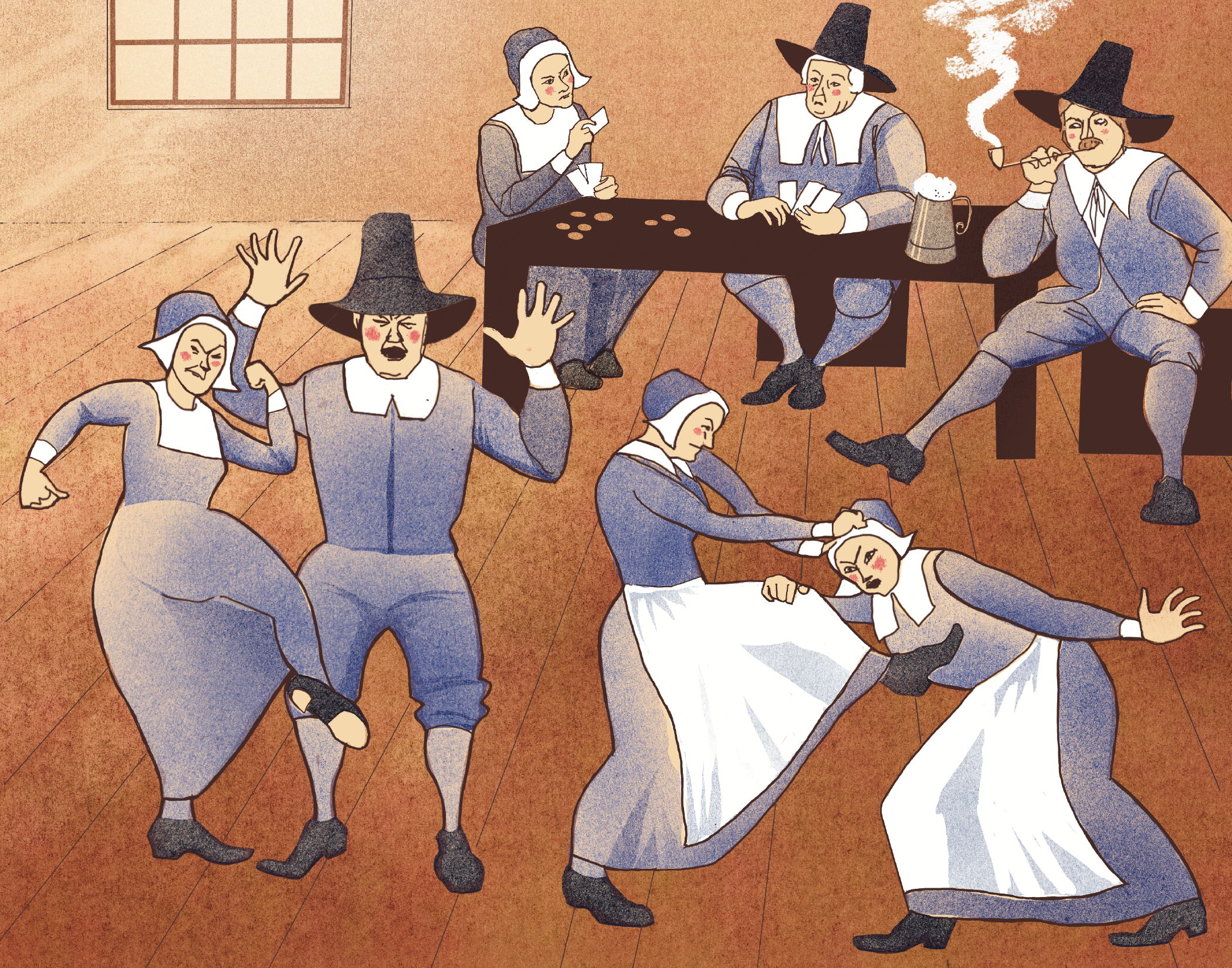
East Hampton society was a far cry from a gathering of saints. Wright cited an East Hampton scandal in 1653, in which “William Edwards sued Benjamin Price and his wife for defamation, claiming that Mrs. Price had called Mrs. Goody Edwards a ‘base lying woman.’” The case fell apart when “witnesses testified that Goody Edwards had kicked the constable and threatened to kill him; that when a man went to the constable’s aid, she kicked him and broke his shins; and that when her husband told her to take her punishment patiently, she threatened to kill him as well.”
The accounts of ungodly behavior get worse. The town, said John M. Murrin in “East Hampton In the Seventeenth Century” — another lecture presented on the occasion of the town’s 350th anniversary in 1998 — “appears more contentious and, yes, cruder or coarser than the typical New England town. Backbiting and slander suits frequently disrupted the town. Several sexual scandals alarmed the residents.” One man was accused of seducing both the daughter and the maid of the Rev. Thomas James, the first minister of the First Presbyterian Church of East Hampton.
And, Murrin added, four men, two of them married and two unattached, “shocked the community in the summer of 1654 by engaging in what seems to have been competitive masturbation.” (Secondary cringe!)
The Rev. Rodriguez likens East Hampton’s early years to America in the 1960s, “when churches were overflowing with people who didn’t really care about God or the central claims of the church. It was culturally what you did if you wanted to have business partners, or you wanted to maintain some standing in society. I don’t think it was any different. . . . I think absolutely there were probably as many atheists back then as there are today” (although they would perhaps have been more likely to keep that fact to themselves, he says).
The reverend directs our attention to the 1662 Half-Way Covenant, a compromise allowing adults in New England who had been baptized but had not had the “conversion experience” required for full church membership, to have their children baptized. This permission was a solution to two problems: declining church membership and weakening religious fervor.
“You have a softening from the center of Massachusetts Bay Colony out to Connecticut — New Haven — and then out to here,” Rev. Rodriguez says. “So by virtue of being on the edge of the Puritan empire, if you want to call it that, we’re already skirting the rules” here in Bonac. “Because if they wanted to be a part of the hard core”— that is, the most fervent and religiously strict colony, Massachusetts — “they could have. That’s where they landed, and they decided to travel far away.”