
Spirit of '76
In 1976, an East Hampton kid could charge a pack of Pop Rocks to his parents’ tab at Marley’s Stationery store. The age to buy alcohol was 18, but it was perfectly legal for a kid of 16 to drink. The bays were full of scallops. The U.S. Naval Academy and the Military Academy at West Point admitted women for the first time in the Bicentennial year. NASA landed an unmanned planetary probe on Mars, and months later unveiled the Enterprise, the first space shuttle. David Berkowitz, the serial killer who eventually became known as Son of Sam, shocked New York City with random murders.
“Some of us were paying attention, but I think we were very much in a bubble in East Hampton,” said Judith Markowitz, who graduated from the high school on Long Lane in 1976, and is on the organizing committee for the class’s 50th reunion later this year. Speaking from her Bay Area home in California, with the live online video stream of East Hampton’s Main Beach on in the background, she continued: “Bubble is a really good word.”
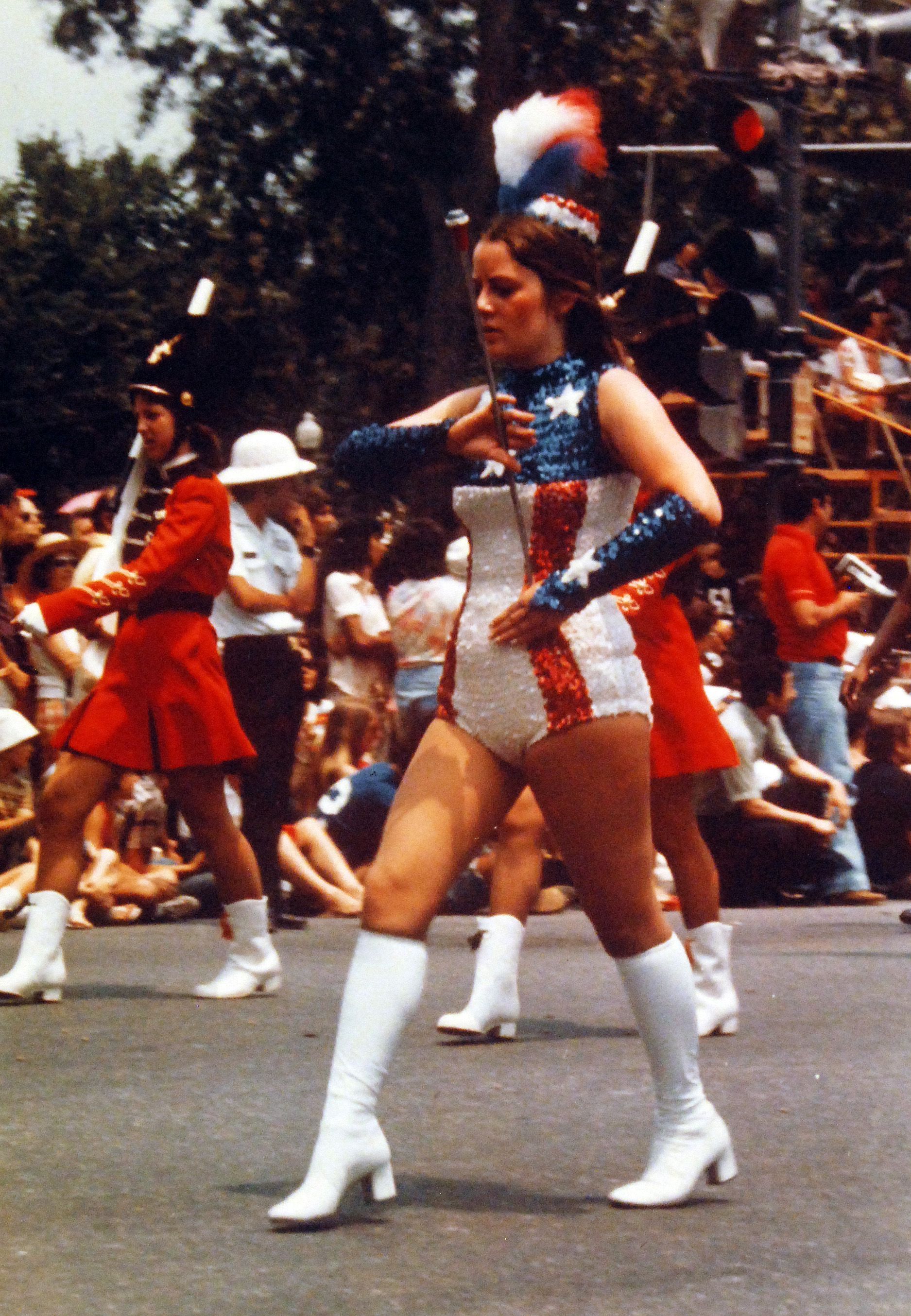
Spirit is another really good word to describe the mood in the country during the Bicentennial, despite that word’s overuse and abuse. From the Merriam-Webster dictionary: “A special attitude or frame of mind . . .” Those who didn’t live through the mid-1970s will have a hard time grasping the genuine and unique feeling of excitement in the air all summer long for the nation’s birthday. Kids played with toy muskets and grown-ups ate cakes decorated with strawberries, blueberries, and vanilla icing for the red, white, and blue. Old Glory was everywhere — on bunting, T-shirts, ball caps, lunch boxes, jogging shorts. Fireworks exploded overhead and a Grand Parade of tall ships, including the Amerigo Vespucci of Italy and the Libertad from Argentina, sailed majestically through New York Harbor.
Stepping Out
In June of 1976, the diplomas issued by East Hampton High School featured the phrase “The Bicentennial Class.” The seniors wore special medallions around their necks at graduation. Tom Ruhle, who grew up in Montauk and later worked for East Hampton Town for more than 30 years, was in the senior class that year, too. On graduation day, after the ceremony, he opted not to party, but rather to see the film All the President’s Men at the United Artists cinema on Main Street.
Party time came later. In 1976, the unofficial headquarters of the nightclub scene was 44 Three Mile Harbor Road, where a disco called Mellow Mouth had recently opened. It was hardly the only club in town, and while it changed hands and names many times over the ensuing years, its legacy has endured. (Today, it’s home to an Italian restaurant.)
“There were a lot of happy people because they didn’t have to worry about Vietnam,” Ruhle said. “The music went from Ohio and Fortunate Son to disco. Dancing Queen by ABBA came out in 1976. There were bad clothing choices. I literally had striped, multicolored bell bottoms. I had a leisure suit, too.”
Ann Filer Bennett, a 1975 graduate of E.H.H.S. who was waitressing at Baron’s Cove while on break from college in the summer of ’76, recalled a place called the Moon on Montauk Highway, where the Landscape Details offices are now. “It had tiered seating that went around, and a sparkly ceiling. We went there all the time. It was close, but it wasn’t wild. Either it didn’t have drinking or I didn’t notice it because I didn’t drink very much. It kind of attracted high school and college people — it was a sweet place to go.”
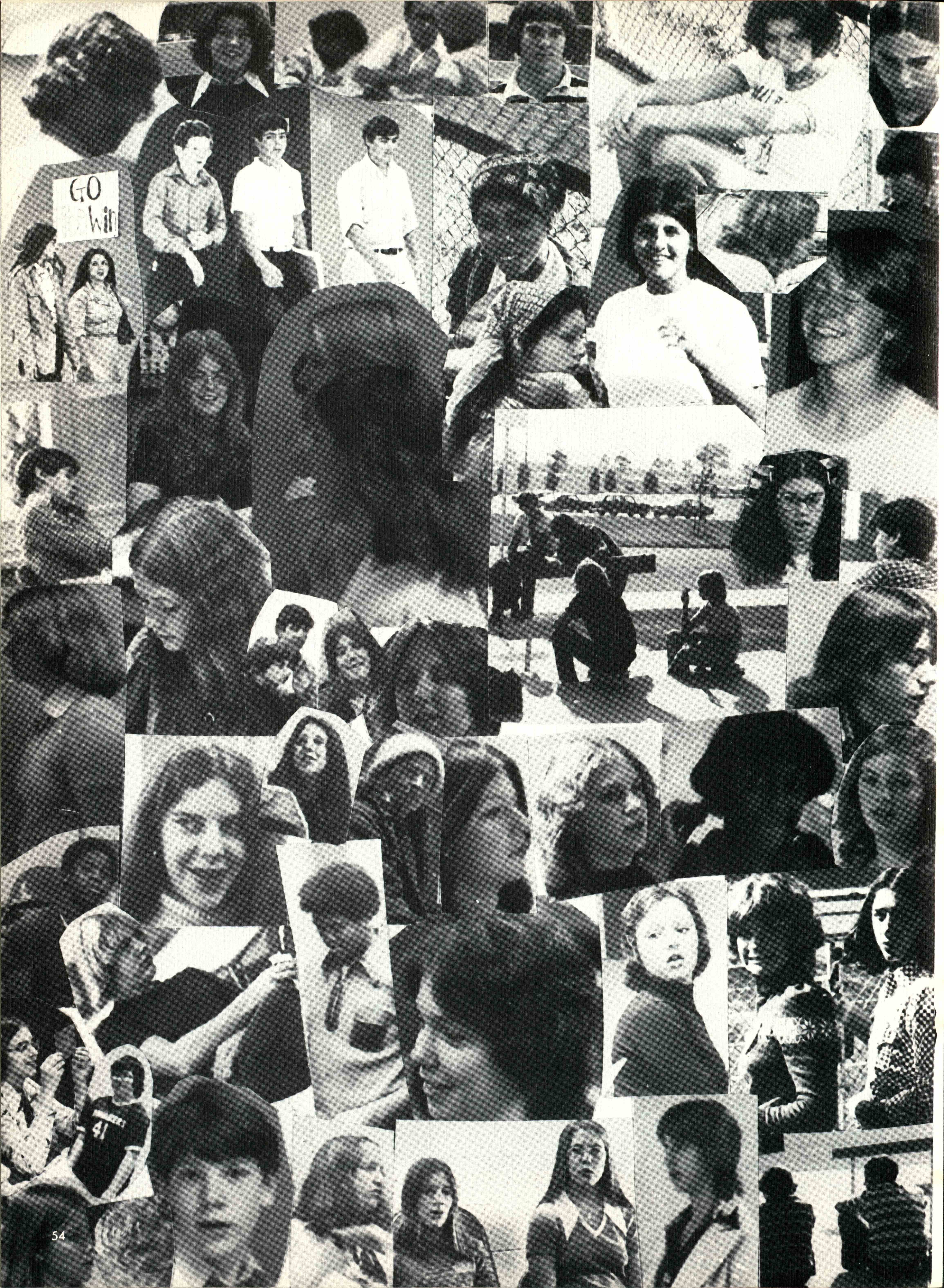
Markowitz, a flutist in the high school marching band, played the piccolo solo when it was time to perform Stars and Stripes Forever in the spring concert. To this day, she said, she and her classmates “know every word” of the school song. “There’s still just a connection,” she said. “Our senior year, our class really came together, and I don’t think many other towns experienced what that was like.”
Fife and Drum
To say simply that “there was a parade” for the Fourth of July in 1976 would be the understatement of the last two and a half centuries.
“Everybody was making floats. It was a huge parade. It was a great parade,” recalled Barbara Borsack. In 1976, she was 24 years old and a new mother. She’d pitched in on the float for the Hamptons Alliance Church, which was to be number 31 in the parade lineup. Jack Graves, the Star reporter covering the festivities, described the float as “a fluffy bell and cross that hid a Volkswagen owned by Barbara and Ted Borsack Jr. Finishing touches were put on as the Borsacks’ 10-month-old daughter, Amanda, played with a camera in a car seat on the grass nearby.”
The scene was unforgettable. “It was packed. It was a beautiful day with wonderful spirit,” said Borsack, who in 2000 became the first woman elected to the East Hampton Village Board and was re-elected to multiple terms over 20 years. “Everybody was dressed in red, white, and blue. . . . You could even buy shirts and underwear that looked like flags.”
Hugh King, the East Hampton Town and Village historian, recalled that everyone on “almost every float or entry into the parade” was dressed in colonial costumes — “really, completely.” He was 35 years old and a teacher at the Springs School at the time. “I think people took it seriously,” he said.
Robert Hayes hadn’t officially signed up to march in the parade, but made a strong political statement about America’s history of racism and slavery without saying much. The Star reported that he “strode” past the reviewing stand “stripped to the waist and wearing manacles and chains,” leaving the announcer, Edward Ecker — who by stark contrast was wearing red pants, a blue shirt, and a white tie — a bit tongue-tied in his commentary.
The Star paraphrased the parade-day remarks of Perry Duryea, the state assemblyman from Montauk — and that legislative body’s minority leader — reporting that he “spoke movingly of life, liberty, and the pursuit of happiness, and the need for assuring that these beliefs were continued for years and years and years to come.” Rabbi Albert Silverman of the Jewish Center of the Hamptons, an institution only 17 years old in 1976, called on people to remember that the Declaration of Independence had been “merely prelude . . . the future is for us to determine.”
From Judith Markowitz’s vantage point with the marching band, everyone in town really did come out: “There’s nothing like hearing the people cheering you on.”
After the parade, three judges evaluated the entries for a cake-baking competition, held at the home of Councilwoman Mary Fallon (who was later elected town supervisor). Two of the judges were Craig Claiborne and Pierre Franey, the legendary culinary artists who were once described by Everett Rattray, then The Star’s editor, as “men who know more about food than anyone else in the nation.”
That night, Barbara Borsack recalled, she and Ted Jr. watched the Fourth of July fireworks show at the Statue of Liberty at home on the black-and-white TV they’d recently bought at a yard sale.
"True Americana”
That year, Alexander and Blanca Leon of Venezuela rented a vacation house on Jericho Road in East Hampton. They liked it here so much they stayed. Their middle child, Esperanza, was 4 years old at the time.
“We were welcomed with great hospitality, great generosity,” Esperanza Leon recalled recently. “I felt completely welcomed, never shunned in any way. Our neighbor, Mrs. Hand, came to the door with an apple pie to welcome us. It was true Americana.”
Leon’s first real memory of East Hampton was the 1976 Ladies Village Improvement Society fair, held on July 30 at Mulford Farm, near Town Pond. An advertisement published one week earlier in The Star declared it would be “the Fairest of the Fairs,” with “a distinctly Anglo-American flavor.” The L.V.I.S. selected blueberry, not apple, for the pie-eating contest, “probably by someone who knew that blueberries flourish on the East End in July and apples do not,” The Star’s Irene Silverman wrote. The L.V.I.S. also promised a “special surprise attraction” for the Bicentennial that they guarded as “the best-kept secret around these parts since the burial of Captain Kidd’s treasure.” Word eventually got out that it would be a huge hot-air balloon.
Leon was too young to remember much else in 1976, but whenever a fog rolls in over East Hampton, it brings her back to those days. The family once went out for a walk to Georgica Beach, but got lost because the thick mist obscured their way back home. “When it’s foggy out here, it transports me and I love it,” she said. “It’s such a thing that I connect to my childhood, like the salt air in June or early July, where it’s mixed with the smell of strawberries.”
Bicentennial Fever
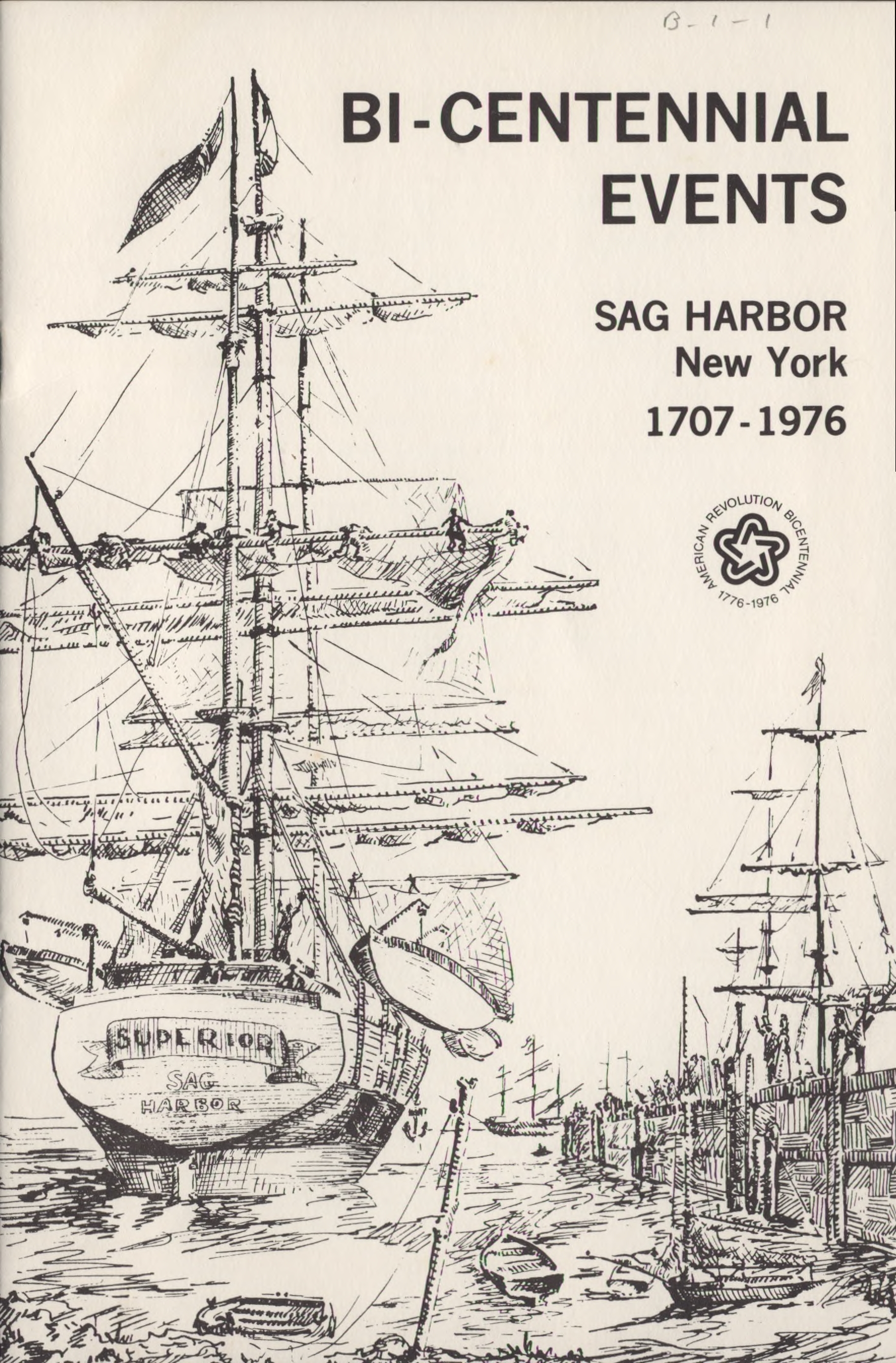
Sag Harbor caught bicentennial fever, too. A program tucked deep into the Digital Long Island Collection — that treasure trove of history maintained by the East Hampton Library — lists more than two dozen distinct parties and public celebrations spread out over the year. In May, the tall ship Rattlesnake docked for three days at Long Wharf as part of the Operation Sail “grand parade” in New York City’s waters. A few weeks later, on June 12, Sag Harbor held a Bicentennial parade, too, complete with an colonial-era arts-and-crafts exhibition, sailboat races, a band, a clam chowder supper, and a gigantic, floating make-believe whale in the harbor that was “harpooned” by rowing crews racing in whaleboats. Also of note: “The Peconic Radio Group will be available to send free radio messages throughout the United States and foreign countries (except belligerents).” The Revolutionary War skirmish called the Meigs Raid was re-enacted on July 10.
On Aug. 14, a pageant at the Minden estate on Ocean Road in Bridgehampton featured an ensemble combining several area church choirs, plus the Southampton Town Militia demonstrating close-order drills and the Sweet Adelines singing barbershop-quartet melodies. The Spin Drift Players — of which East Hampton’s Hugh King was one — performed a historical skit titled The Way It Was, based on Bridgehampton’s role in the American Revolution.
On July 2, The New York Times published an exhaustive list of activities across Long Island, but listed none on the South Fork farther east than East Hampton. Maybe everyone was busy fishing? “Lake Montauk, in those days, was clear in the summer,” Ruhle recalled. “There were fish all over the place. I remember going clamming and tripping over scallops left and right because there were so many of them.”
South of the Highway
A community that could still go down to watch the haul-seiners pulling in their nets at the ocean beaches — and which had the brand-new ability to debark from the Long Island Rail Road at the new stop at Southampton College — suddenly found itself in the spotlight. Decades before the onset of reality TV and the arrival of Instagram influencers and television gossip crews on the South Fork every summer, there was Grey Gardens.
The predicament of the Beales had first been reported in the pages of The Star, which for a few years had documented the ramshackle state of the Kennedy cousins’ once-stately Shingle Style home by Georgica Beach, and the string of code violations that brought unwelcome village officials knocking on their door. The film documentary was released in theaters in 1976, filmed and directed by the brothers Albert and David Maysles in their signature cinéma-vérité style, sans narrator, sans musical score. The moviegoing world got a glimpse of the south-of-the-highway life of the famously eccentric, and reclusive, aunt and cousin of Jacqueline Kennedy Onassis: Edith Ewing Bouvier Beale and her daughter, Edith Bouvier Beale, known as Big Edie and Little Edie.
Walter Goodman reviewed the documentary for The Times, angered over the filmmakers’ treatment of the eccentric women: “The sagging flesh, the ludicrous poses, the prized and private recollections strewn about among the tins of cat food — everything is grist for that merciless camera. The sadness for mother and daughter turns to disgust at the brothers.”
Church and Synagogue
American Field Service was — and still is — a popular program that connected East Hampton to the rest of the world, placing foreign-exchange students with host families in the U.S. In 1976, the Markowitz family hosted a Malaysian girl, who remains a close friend today. “It was really an impactful year to host her,” Markowitz said.
Once upon a time, East Hampton’s faith communities centered around Christian denominations, notably the Presbyterian church — where the Rev. Samuel Buell was pastor when the Declaration of Independence was signed. But Markowitz’s family history is intricately woven into Jewish life in East Hampton. Her parents, Charlotte and Irving Markowitz, were among the founders of the Jewish Center of the Hamptons.
“One of the things that really stands out for me is that I never experienced any antisemitism in East Hampton. And we were a very small group of Jews,” Judith Markowitz said. “The reason was that we were all blue-collar. There wasn’t a financial status difference. There was biracial dating back then, too. We didn’t think there was anything wrong with it.”
Oscar Giles, a 1975 East Hampton graduate who still lives locally, described a parallel experience as a Black youth in a predominantly white community. Most of the time, he said, he didn’t face the kind of racism common to other places on Long Island and the U.S.
“There were a few times, but everybody knew everybody. Everybody spoke to one another. Nobody had any bad regards for anyone. No one felt menaced,” said Giles, who has been married to Diana Bennett for 40 years. “My wife being white had it harder than I had it as a boy.”
History Lessons
In 1976, the residents’ connections to the history of East Hampton were much more tightly tied. Bonackers hadn’t yet started leaving in droves in moving vans paid for by the sale of family property that became more and more wildly valuable the more popular the place became.
Ann Filer Bennett married David Bennett (of Texas Bennett lineage, not East Hampton), who had been a military man, which meant moving around a lot. In 2017, when they retired and were finally able to stay in one place, they built a house on a piece of property in the Northwest Woods that had once been a Filer family “wood lot,” and by 2019 they were living here full time.
“My husband said, ‘You can sell it.’ I said, ‘I can’t sell it.’ He didn’t understand generational attachments until he got here,” she said.
Giles, now retired from a 30-year career with the New York State Highway Department, feels that bond, too. “My wife sometimes says we should leave, but if you leave, you can’t afford to come back,” he said. “My daughter moved to Florida, and my granddaughter lives with us now because it’s so hard for a young person to find affordable housing.”
The arrival of “groupers” in the 1970s spurred the town to start finding ways to control a changing population. It began implementing rules to control things like the number of cars that could be parked at a residential property. “That was the first generation that was kind of ‘new money.’ Before that it was old money, like the Great Gatsby kind,” Bennett said.
If you grew up here, you grew to appreciate history. “The history alone is so fascinating — the local stories, the people who were there and the people who were there before the Bonackers,” Markowitz said. “I would say that growing up there instilled the importance of knowing where you came from, and how you got there, and who came before you.”
More Than a Feeling
There was a sense that the Bicentennial celebration in East Hampton was unburdened by much of what had come before.
“I think everybody was so relieved with Watergate over and Vietnam over,” Barbara Borsack recalled. “It was a time of relief in the country, probably like the post-World War II years when spirits were high. Not that there weren’t bad things happening, but people felt some normalcy again. I don’t think we feel normalcy right now.”
Tom Ruhle echoed her comments, describing a social-political culture in 1976 that was unified even in its differences.
“There were Republicans and there were Democrats, but we all loved America,” he said. “Now it’s divisive — this ‘who’s a real American’ crap, we didn’t have any of that. We just talked about how wonderful America was.”
He said he feels like 2026 is “more low-key” in its approach to celebrating: “Maybe it’s because we’re fighting a war and having mass protests in the streets.”
“People are questioning where we’re going and what’s happening,” Borsack said. “I think the country is kind of in shock and can’t get their minds around celebrating right now. But 1976 was a great year.”