
Are the Knicks a Religion?
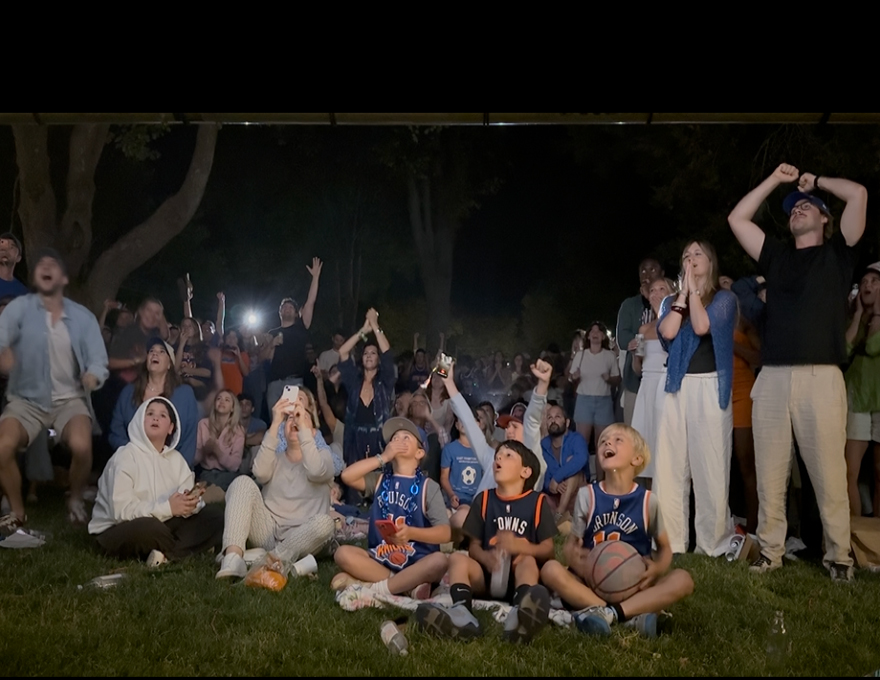
A watch party can feel akin to a religious experience. A congregation of believers train their eyes upwards, offering incantations to a screen through which a divine battle plays itself out. The laws of physics dictate that chants like “Let’s go Knicks” can’t actually reach the players or have any bearing on the game’s outcome — MSG is about 100 miles away — but like in any good worship, believers felt moved to cry out in rapture anyway.
I’m an atheist — the problem I have with the big religions is that they ask and promise too much: suspend all disbelief and internalize anachronistic tenets, and God will punish your enemies and grant you everlasting happiness. The actual benefits, like charity and community, emerge as accidental byproducts.
But the Knicks offer a kind of modern religion, one that acknowledges its limitations — it’s not promising salvation, just a good game.
The ecstasy of the NBA Finals has demonstrated that a good game is no small thing. The city spills out into the streets to watch every match. Its skyline is illuminated in orange, blue and white. New York State is home to around 20 million people — almost 24 million viewers watched Game 3. People are getting Knicks tattoos.
If Christianity revolves around God’s perfection, the Knicks offer a reasonable alternative: human excellence. The players, all genetically bestowed with gifts of height and speed, have trained nearly every day of their lives since childhood to dribble, pass, shoot and guard.
The true excellence of the Knicks, though, is not consolidated in any one player. It occurs within the team’s dynamic, in the way that players — a block of whom played together in college — can read each other’s bodies and foresee moves before they occur. This synchronization gives way to a profound brotherhood; the men love each other. When Karl-Anthony Towns embraced OG Anunoby at the end of Game 4, it was with radiant depth of feeling. In nearly every post-game interview, the players say they were able to pull through because they knew their teammates had their back. To rely on and be relied on — what greater aspiration can a social animal have?
Fans can tap into this brotherhood, feel its reaches extend to embrace the city. We forget, because America is so radically uncool, how powerful a force patriotism can be. In other eras — during legitimate wars — people used to say the pledge of allegiance and feel a swell of gratitude and pride in their hearts towards the soldiers protecting them against Redcoats or Nazis. During the NBA Finals, we feel these swells towards the Knicks for fighting so fervently on the court.
The team’s success helps crystallize New York City as a place worthy of pride, distinct from a nation held in disdain by the rest of the world. And coincidentally, the team reflects a distinctly New York narrative back to the city. It’s scrappy and intrepid; the 6-foot-2 Jalen Brunson overcomes 7-foot-4 Victor Wembanyana with speed and cunning. Just when you think hope is lost — a 29-point score gap in the third quarter — the Knicks turn it around and win by the skin of their teeth. Game 4 was the biggest comeback in NBA Finals history. Fans called it a “miracle.”
That basketball is completely arbitrary — grown men throwing a rubber orb into a ring with fabric hanging off it, running around according to lines drawn all over the floor — only makes it more moving. It captures a more essential truth than religions who try to wrap everything up into a coherent, divine plan. Reality, as far as we know, is random — there’s no reason for something to exist over nothing, no reason for us to have big brains, no reason to live except for life itself. A basketball game is an expression of that randomness — it means nothing outside of the meaning we’ve collectively decided on. But when a team meets this randomness with excellence, it transforms human triviality into something holy: Just because it’s all random doesn’t mean it’s not worthwhile.
When a reporter asked Anunoby about his history-making Game 4 basket, he responded simply, “I inbounded the ball to Jalen. He got a pretty good look, and I just went and crashed. Tried to get a tip-dunk or something. The ball went over my head, so I couldn’t really dunk it. So I tried to tip it in softly, and it went in.” He didn’t have to invoke a divine plan — the literal, technical excellence is good enough.
This article is adapted from a post on our Substack