
The Stargazer
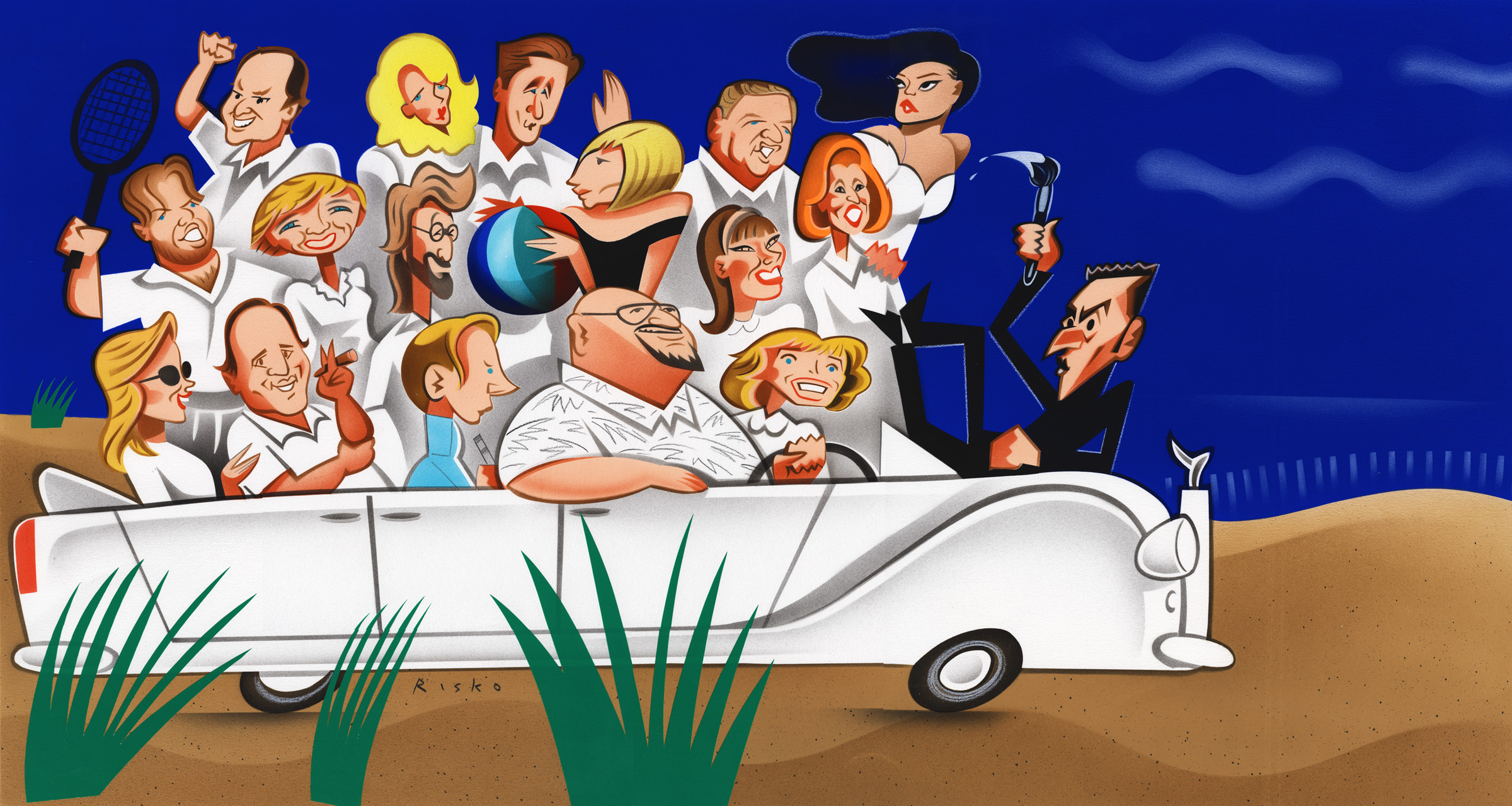
Q. How did caricatures become your medium?
Ever since I was 4, I’ve always drawn people. I drew my teacher Sister Monica in the first grade. She gave us a drawing assignment and left the room. I remember drawing a profile of her. She had kind of a prominent nose and a long veil. A friend said, “Look what Risko did. Draw me before she comes back.” So, I managed to draw at least five or six before she returned. And she said, “Well, a lot of them are very good, but I have a feeling that some people had some help in here and I have a feeling I know who’s behind it.” She was smiling, and she looked straight at me.
Years later, I was a caricature artist in the summers. In my third summer, up in Provincetown, I met Bobby London, a cartoonist from National Lampoon who said I was good. I could be the next [Al] Hirschfeld. I should go to The New York Times, because Hirschfeld is old, he’s not gonna last forever. He was 76 at the time, and I think he lived to 100. I’m glad I didn’t wait.
Q. How did you meet and work with Andy Warhol?
Well, the thing about Andy Warhol is, he was always a presence in my psyche because I grew up just outside of Pittsburgh in a small town so I thought if he could do it – some Ukrainian from Pittsburgh – I can certainly follow that path. It was a chance meeting. I went out to Fire Island and he was signing copies of Interview with Halston. I showed him my business card with a caricature of Diana Ross on it. He said, “Robert Risko.” I said, “Have you seen my work anywhere?” And he went from blank face to a smile. I said, “I would really love to work for Interview magazine.” He said, “Yes, yes, yes, call the magazine on Monday.”
Q. A question in the spirit of 250 years of America: Gilbert Stewart liked to paint George Washington’s portrait because of his nose; are there features you like to focus on in a caricature?
I love drawing anyone with strong features. When I was younger, I used to draw Diana Ross all the time. Andy was obsessed with her. The roots of my work go back to Egyptian and African art. I don’t see my work as having roots in classicism or realism, like Greek and Roman art, otherwise it’d be like Madame Tussaud’s wax museum. Egyptian art has a very spiritual quality to it and it comes from the abstraction. I think you get a better likeness from abstraction, because there’s movement and you can create a sense of animation in the stylized manner in which it is drawn.
I’m going for the aura of the person, rather than a literal likeness. I will draw a person over and over again until it looks like it was drawn by a child. I’d compare it to, say, a violinist who’s rehearsing music until it has a very innate quality like it came out for the very first time.
I was reading a book about caricaturists written by some Brit way back when, and it said that America is not ready for caricatures because it’s too young a nation. The Brits love a good caricature. The longer the nose, and the more pores on the face, and the pimples – the more they love it, you know?
I don’t know exactly what it meant by being a “young nation.” I guess we have to go through this phase of beauty and vanity, and then realize that beauty is so fleeting, and that’s not the most important thing in the world. Something else will come up, other values, maybe. Intelligence, confidence. Getting older is humbling, but it’s also a privilege, and I think one should allow the world to see the life that you’ve lived.
Q. You’re returning to Vanity Fair, where you worked for decades after starting with the team that redesigned the magazine in the 1980s. How have things changed since then?
I want to do things only in black and white. I loved the black-and-white era. I loved Interview magazine when it was black and white on newsprint. Maybe it’s a sanctuary effect, it has a soothing quality. An old black-and-white movie is comforting to me in some ways.

Q. There’s a long history of artists in the Hamptons. Why did you gravitate here?
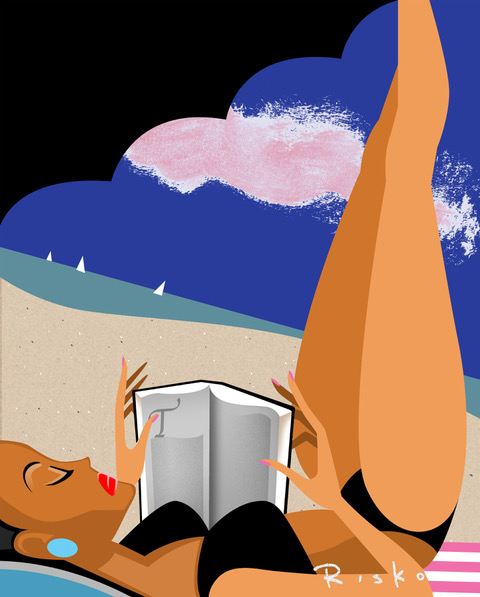
Ever since I had a taste of the ocean, I’ve been addicted. I just think being by the ocean, hearing it, even having that heavy ocean air all around you. There’s something dreamlike. When you look at the shoreline and you see where ocean meets the sand, you’re seeing the raw elements of creation in a way.
I wasn’t sold on it at first but I saw this little cottage in Springs. And it was like . . . out of the past. It reminded me of black-and-white photos that my parents had, when they would go on vacation in Maine. It had that kind of shingled austerity to it, this cottage out of the past. I think there was something in me that wanted to relive my parents’ youth, and I think about this all the time, actually.
The thing about the Hamptons today – with all these big houses being built – I hope that the humble houses don’t become completely erased because that’s what makes it so special. The New England-style houses that were originally here are very haphazard, but so charming. You couldn’t have planned it any better. All these gray houses and with the white trim – when the light hits there’s just a magic, you know?
I remember when they put a gazebo in East Hampton Town, because they thought it would be a nice idea to have something covered for the people to wait in for the Hampton Jitney. Well, East Hampton had that gazebo taken away.
They said, “We’re not having that. This is not what East Hampton is. We are not a gazebo type of town.” It was such a to-do. And that was in the 1980s. Oh my God. But now you see these modern houses and you think, a gazebo would be welcomed compared to what’s happening now.
Q. Do you come out here to be energized, or is it a respite from the city’s buzz?
I would say it’s more of a respite, but with a respite you do get energy. Nature heals you; It gives you energy.