
The One-Percent Sale
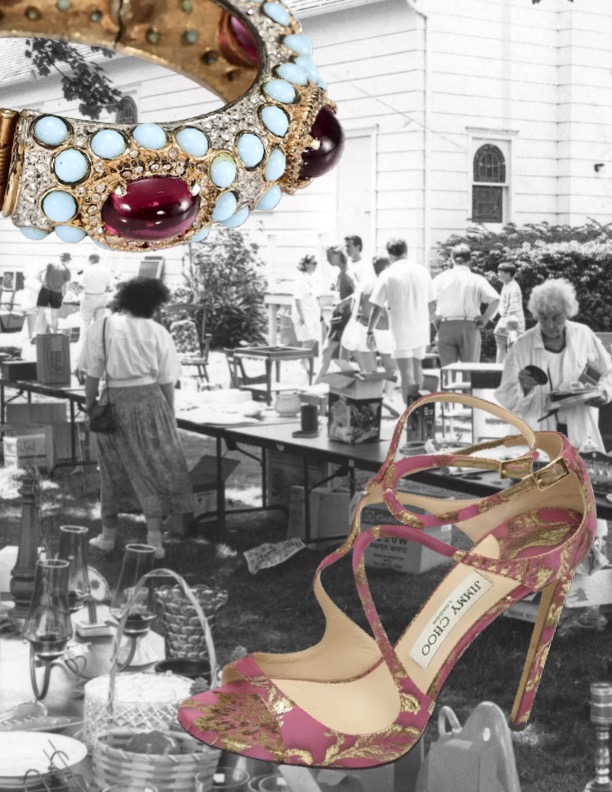
When Melissa Aery was growing up in Southampton in the 1960s and ’70s, thrifting wasn’t a verb, but she was familiar with the concept. Her mother was an avid yard-sale-goer and Aery soon began to tag along. By her late teens, she was a regular at local sales, feeling the jolt of excitement any bargain-hunter gets when they approach an unknown haul.
“If you didn’t get there first at 7 o’clock you missed that old bowl you really wanted,” says Aery, now 70. “All the antique dealers would go to these yard sales and they were the first ones there,” vying for the best stuff. Eliza Werner, the longtime owner of Sage Street Antiques in Sag Harbor, was one of them. “It wasn’t pleasant,” she says of the competition. “A lot of aggressive people.” Eldon Wong, an interior designer based on Shelter Island, also recalls those days. “You would have to jostle and grab things from people” as you scoured a sale for finds, he says.
But yard sales on the East End have changed a lot in the last few decades. “Here and there there is something decent, but it’s not the same,” says Werner, who, with her cropped red hair and hawklike eye, is recognizable to anyone who has haunted these sales in recent decades. Wong notes that many older homes, full of antiques and curios, were sold off a long time ago, so there’s less inventory now, or at least the kind that interests him. He remembers the time when he’d sometimes hit multiple sales in a weekend. “It’s kind of a nice way to see different interiors and see how people from all different financial backgrounds live,” he says. His best find? A chandelier from a famed Italian glassmaker, which he first encountered in pieces on a garage floor. “I grabbed it, took it home, and I realized, ‘Oh, it’s a Venini chandelier!’ It was a spectacular find.”
While the scene has changed, opportunities for yard-sale addicts still exist. It’s just that today, they’re likelier to come in the form of estate sales — yard sales’ grander cousins. The difference? An estate sale is not an informal backyard affair put on by a family or group of neighbors on a casual weekend morning, but is a more professional affair in which the entire contents of a house are liquidated. Estate sales, typically, are run by a company that specializes in the service.
On a drizzly Saturday morning, Aery arrives at an estate sale she saw advertised in the paper earlier that week. It’s at a shingled house near the water in Sag Harbor, owned for years by a couple who are now gone. Aery plunges in with abandon. She heads first to the garage where she rifles through mysterious old tools and gardening paraphernalia, and plucks out some outdoor lanterns. Then she enters the house. This is her kind of sale. Here a solid, middle-class family life is laid out on display: brown furniture, a collection of Depression glass, leather suitcases with tags from long-gone airlines, a toddler’s tin horse, and most of the items from a midcentury kitchen (including an old Hoosier baker’s cabinet), among many, many other things.
There’s a 1937 Chevy sitting in the driveway when she arrives, but by the time she leaves, it’s gone — sold for $5,000 in cash to a neighbor who had long admired it, says Yasemin O’Neill, owner of Estate Sales by Yasemin, who is running the show. O’Neill then had to field an angry call from a man who’d seen the car the day before, and had checked on its availability earlier that morning. He was on his way back out from New York in his own car to buy it. “This guy was furious because I had to tell him to turn around and go home,” she says. At her sales it’s first come first served, and cash only.
The prospect of an enticing find has people lining up at sales long before the doors open. There were 80 people waiting when the Sag Harbor sale began the previous morning, O’Neill says. Some came from as far away as Pennsylvania, lured by photos of items posted to social media. When visitors swarm in, emotions can run high. Diminutive and wearing four-inch heels, O’Neill has had to break up fights at some of her sales as someone attempts to cut the line, or leaves a pile of items in the corner only to spot another buyer plundering their stash.
Despite what the name suggests, most estate sales on the South Fork don’t take place after a death, but rather when someone moves. And the rate at which second-home owners buy and sell is fueling a boom in estate sales, and the profits of the companies that run them.
“They literally leave everything,” says O’Neill. “It’s like they just decide they’re done.”
One of her biggest successes took place when she visited an oceanfront estate to get an idea of the owner’s possessions. After a tour of the property, she noticed several stuffed black trash bags near the door, all ready to be picked up by a junk service. She asked the owner if she might peek inside.
“She said, ‘Oh, nobody would want this.’ And she showed me,” says O’Neill. “It was — in boxes still — Prada, Chanel, Louis Vuitton.” Clothing with the tags still attached, sunglasses, and boots.
Each item had been destined for the dump. “That sale generated, just from those trash bags, $75,000,” she says.
She loves the social aspect of sales, and has lots of return buyers. (“Where are they putting all this stuff?” she asks. “But they keep coming back.”) While O’Neill enjoys chatting about her wares, seeing what buyers pick out, and meeting their kids, Abigail Cane of White Goose Estate Sales doesn’t care for the social aspect one bit. Cane, who started White Goose in 2012, went entirely online during Covid, and has never looked back.
“We were scraping to get by pre-Covid, and once we pivoted to online, now we’re national,” she says. “My best customers are in Texas and California.” Being online means using a site like AuctionNinja to host the sale; people bid on beautifully photographed items from the comfort of their phones. She says an in-person sale used to garner an underwhelming 10 cents on every dollar of her clients’ belongings. “We’re now seeing between 50 and 80 cents returned on every dollar” and making good money. A couple of years ago she staged a sale that brought in a quarter of a million dollars. “That didn’t happen in person ever,” says Cane.
Another advantage of online, as Cane sees it, is that she no longer has to worry about looky-loos tromping through her clients’ homes, eyeing but not buying, and sometimes leaving damage in their wake. “I would notice someone ripped a towel bar out of the bathroom and my guy would have to fix it,” she says. In the virtual world, everything remains as pristine as a Restoration Hardware catalogue. Indeed, a lot of today’s estate sales — online and off — feature almost-new furniture from houses used only as short-term weekend or summer retreats. Buyers clamor for it.
For Melissa Aery, though, it’s the chance to find something quirky, unique, or handmade — something with a story — that draws her to these sales. She has spent 50 years refurbishing yard-sale items and giving them an upgrade in the house where she and her late husband raised four kids: old doors, mirrors, hand-sewn table linens, and chamber pots have all been given new life and purpose in her home and yard.
And while she has often felt disappointed that her grandkids’ generation doesn’t pine for antiques, that’s changing. “I follow some of these girls that thrift on Instagram,” she says, “and they’re all looking for the grandma stuff again.”
It warms her heart that the young once again appreciate the old, and that a new generation is feeling the thrill of the hunt and the touch of an old monogrammed napkin.
Insider Tips From Yard Sale Hounds
When: Many sales will take place over two or even three days. It used to be that sales were on weekends, but nowadays estate sales may begin as early as Thursday and go through Saturday or Sunday, depending on which company is running the sale. Some sources, including the decorator Eldon Wong, suggest EstateSales.net as a great place to check. You enter the local ZIP code and they bring up sales according to distance. AuctionNinja.com is a good place to find online auctions, including some happening here locally.
Where? Look for listings in The East Hampton Star and the Press News Group, and check the Instagrams of the reputable companies: White Goose, Privet, Estate Sales by Yasemin, etc. Or, if you’re up for it, just leave the house by 8 a.m. on a Friday or Saturday morning between April and late October and cruise around looking for yard-sale signs taped to trees and stapled to electric poles — the family-run ones are still out there and often yield surprising vintage finds.
Etiquette: The early bird gets the worm. Be there for the opening on the first day to get the best choice of items. But be polite, not pushy! If part of the house or an outbuilding is off limits, keep your nose out of it. Many sales are cash only, even when the operator is selling items worth thousands of dollars, so be prepared. It’s acceptable to ask if the seller can “do better” on a price, but try not to insult them with a lowball offer (after all, that old quilt or vintage rack used to belong to grandma and grandpa). On the final day of a sale, everything is usually half price.