
Beach Club Bloodbath
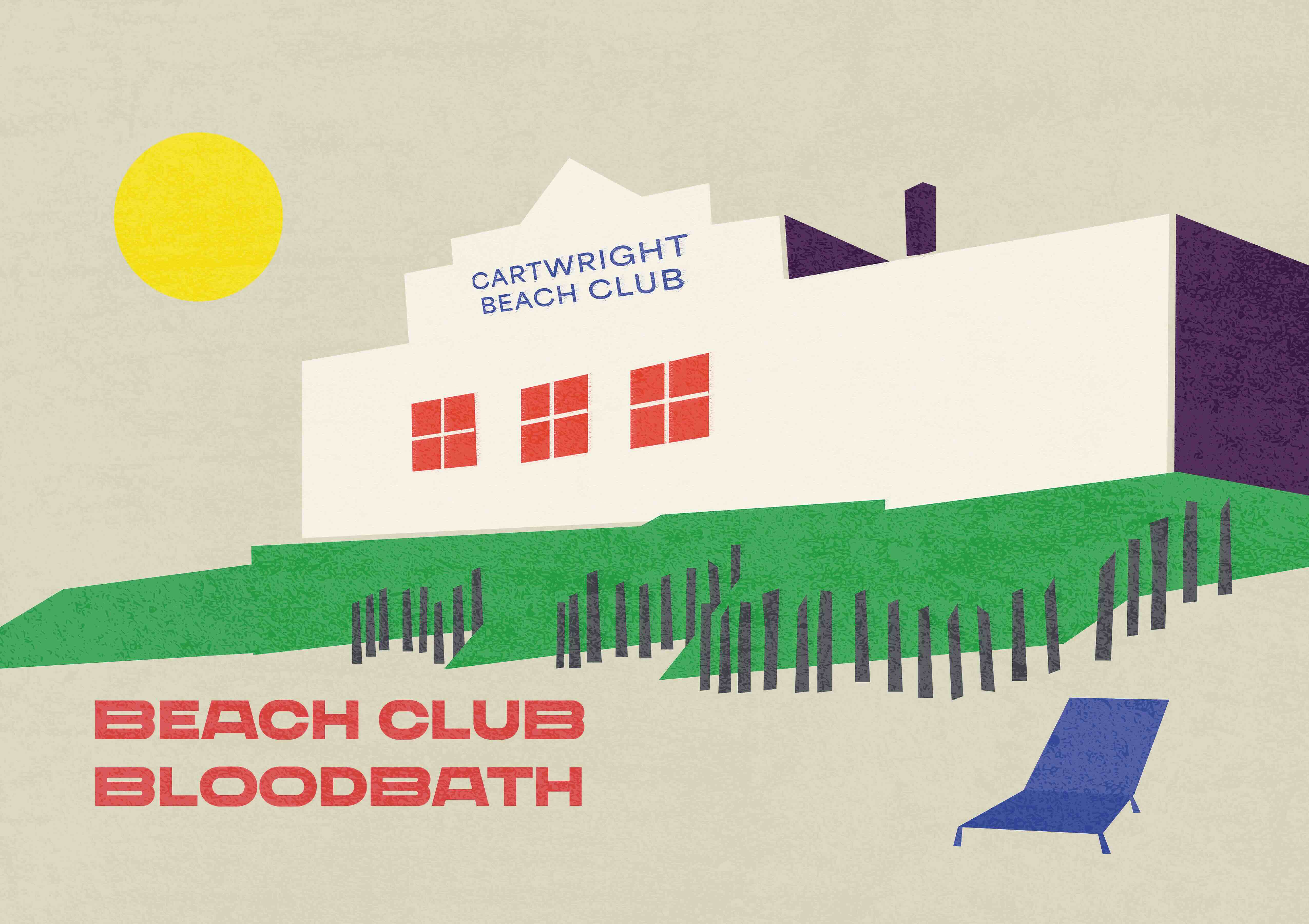
Although the Cartwright Beach Club would be the last place he ever worked, Ben believed it would be his new beginning.
Located on a secluded stretch of glorious beach, the five-acre property sat right near the shore, hidden from the road behind dunes and tall beach grass. The main building housed a concession stand, a storage room for beach chairs and umbrellas, a members’ locker room, an abandoned swimming pool, and the manager’s office and living quarters — now his own.
Built in 1927, the club had seen better days. Its dilapidated wooden structures, splintering and stained by moldy paint, seemed haunted by disgruntled ghosts of its former glory. Its membership consisted largely of the remains of East Hampton’s landed gentry — people with the same last name as the founders of the “summer colony” who did not have the wealth, standing, or refinement of their ancestors. Still, the Cartwright’s 12-year waitlist gave its members the illusion of sophistication, the conviction that they still held an elevated position in their community.
When he took the job in late April, Ben had five weeks to get the club open. He worked alone, ten hours a day, scraping and painting the entire facade, repairing rotten wood, installing light fixtures, restoring and setting up the two lifeguard stands, cleaning out cobwebs, and hiring the summer staff. He’d never hired anyone before and found it gave him great pleasure.
First he rehired the concession stand manager, Barb Morris, who had manned the stand for the past dozen or so years. Barb had invented the club’s signature sandwich, the CartBite: fried bologna, tomato, iceberg lettuce, capers, garlic, and mayo on toasted white bread without crust.
Next he rehired Spanky Kirk, the security guard/parking lot attendant/valet, who’d had the job since he was 15. Now 43, Spanky still had the same bright-red hair, freckles, and broad shoulders that he had at East Hampton High School, where he’d been on the football team.
Because the Cartwright had to compete with several other beach clubs and it paid just below the going rate, Ben had a harder time hiring the lifeguards. He found an assistant head lifeguard in a 42-year-old named Dennis Lambert who answered an ad in The Star.
Although Ben himself had never trained to be a lifeguard, he at least knew how to swim. Dennis did not swim. He had a severe case of aquagenic urticaria: He was highly allergic to water. Moreover, Dennis had served time in New Mexico for grand larceny. He, however, fit the part — tan with scruffy blond hair and very fit. Ben therefore believed that Dennis possessed the right gravitas for the job.
“I dunno what the hell it is, man, but kids just respect me,” explained Dennis when Ben asked for qualifications. “I’m not a father but I have a bunch of nieces and nephews, and I had two stepkids. Kids just listen to me. They do what I tell them. And I never, ever hit one in my life. My ex was full of shit.”
Dennis continued, after a brief pause, “Yeah and I’ve been a lifeguard all my life. I’m a little rusty — haven’t been on the stand in a few years, but it’ll come back. Besides, I’m not gonna be making any rescues. That’s why we got the kids.”
Satisfied, Ben asked, “What brings you to East Hampton?”
“I live the van life, man. I have for years. My parents raised me on the road. I’m camping over in Hither Hills. Do you need some references?” Ben said he didn’t and hired him on the spot.
Over the next few weeks, Ben hired the remaining six lifeguards: Felicia and Felicity Kosmopolis, 17-year-old twins who had never lifeguarded; Kris Foonman, 23, a highly competent lifeguard who’d been fired from every beach he’d worked for “insubordination”; Darcy Hickey, 24, and Darla Hickey, 22, sisters who had their lifeguard licenses revoked for “conduct unbecoming of a first responder,” and Stan Marble, 24, an artist and the son of the 1960s radical thinker and writer Maurice “Red” Marble.
Ben assembled the staff for the season kick-off meeting and announced: “I’m proud of this stellar team. Let’s make this the best summer ever.”
The Cartwright Beach Club customarily opened its doors the weekend before Memorial Day, and Ben was able to pull it together and open on time. Although attendance so early in the season was typically sparse due to cool air and cold water, the sun came out that Saturday and a dozen or so members checked in to sit on the beach and read. Barb’s concession stand did a decent business selling coffee and the occasional CartBite. All of the employees on duty reported to work on time.
But mere hours after the successful opening, Bobby Bellach and his wife arrived.
When he saw him, Ben’s stomach twisted. He hadn’t known that Bellach — his former boss at the I.G.A. — belonged to the Cartwright. Unluckily for Ben, the Bellach clan had settled in East Hampton in the 1800s. One street bore the Bellach name. Bellach’s grandfather donated some of the land on which the club stood.
Bellach did not immediately see Ben, but it would be only a matter of time before he did. Ben knew that Bellach would tell the higher-ups to fire him. He felt a desperate need to neutralize this obstacle to his dream job, his new beginning, his return to power.
Ben impressed himself with how quickly and easily he came up with a plan to take out Bellach. He only wished he’d had more time to devise something more fitting to even the score with the loser who fired him. He’d love to tie him up and roast him on a spit like the legends about Henry on Gardiner’s Island. He could hear Bellach’s skin fry and turn bubbly black and ooze blood. Bellach would scream for a few minutes but would probably faint
pretty quickly. Once dead, he could use the I.G.A.’s butcher room to slice Bellach up according to the market’s demands: Were they low on ribs? Might they need more liver? Or how about some ground beef?
But Ben needed to act fast and he needed to be discreet. He slipped into his room to search his belongings for the small vial he carried in his wallet, containing a poisonous compound called tetrodotoxin, or T.T.X., that lives in the liver and ovaries of blowfish.
Ben radioed on the walkie-talkie over to the beach, which was about 135 yards from his office.
“909 to Foonman.”
“Foonman, over,” responded Kris.
“10-19.” Silence.
“Uh, sorry, what’s that mean?”
“It means report to my office.”
Ben sat on his wobbly stool facing his desk, which consisted of a three-foot-wide piece of plywood running along the six-foot wall opposing the door. Ben remained seated when Kris entered the office. Kris stood against the rear wall and said: “Hey, what’s up?”
Ben continued to face his desk with his back to Kris.
“First of all, you have to learn the codes. We run a tight ship. Next time you miss them, you’re gonna have to give me 100 push-ups. Is that clear?”
Kris needed this job. He said, “Bro, no problem.”
“Next, you need to learn how to address your superiors. From now on, you address me as Sir or Mr. Shepherd. Is that clear?”
Kris had been fired from every job and he really needed this one. He responded, “Yes, sir.” Sir. Nobody had ever called Ben this. It made him feel like the important person he’d been circumstantially denied the chance to be. Satisfied that Kris had suffered enough, he swiveled on his stool to face Kris. Kris looked like he had been slapped around by his father.
“Kris, you are the best guard I have,” Ben said. “So I’m gonna be pushing you cause you can take it. It’s for your own good. And I’m pushing you up. I’m seeing a bright future for you here, Kris. Keep it up. The sky is the limit.”
Kris didn’t quite know how to take this, but his expression changed from a scared kitty to one peeking out from under the bed because his owner had mentioned a forthcoming treat. Kris said, “Thank you, Mr. Shepherd.”
“No, please, call me Ben.”
Kris sat in silent bafflement. Ben continued, “I’ve got something I need you to personally handle for me.”
Happy to be asked to help, Kris said, “Of course, what is it?”
Ben said, “There is a member here — Mr. Bobby Bellach — who is one of our oldest members. He’s a good man. The club wants to show him some appreciation but we need to be low key. We don’t want to embarrass him.” Now eager to do anything for Ben, Kris said, “Okay, what do you need me to do?”
Ben explained that Bellach loved the CartBite sandwich. He asked Kris to go into the concession stand and ask Barb to make a CartBite, tell her it’s for Ben, wait for it, and then take it to him in the office. Kris obeyed. When he brought it back, Ben pretended to be on the phone and asked Kris to leave the sandwich and to return in five minutes. During his absence, Ben sprinkled a good amount of T.T.X. on the bologna. Kris returned and Ben asked him to take it to Bellach down at the beach.
Kris found Bellach sitting under an umbrella with his wife, Madeline. When Kris presented the sandwich to Bellach as a gift from management, Bellach seemed caught off guard; he’d never gotten anything free from the club. He took it and thanked Kris. Kris beamed, feeling he had done good and would get this unpredictable boss’s approval. After Kris walked away, Bellach passed the sandwich to his wife. Madeline loved the CartBite. She dug in, wolfing it down and saying, “This weather always does something to my appetite.”
Kris reported back to Ben, who said, “Thank you, Kris, good job.”
Forty-five minutes later, Madeline started to feel dizzy and a little queasy. She convulsed. She vomited. She convulsed some more. She passed out. Bellach cried for help. “Help, help, lifeguards! My wife!” Dennis and the Kosmopolis twins ran over. Bellach beckoned them to assist her. Dennis said:
“Yo, I’m not a doctor. What’s the deal with her?” Bellach grabbed Dennis by the whistle and pulled him down to his wife lying on the sand and yelled, “Give her C.P.R.”
Dennis shouted, “What the fuck, dude.” He tried to perform C.P.R. but he didn’t know how to do it and Madeline vomited some more and choked on it. An ambulance arrived
too late.
The next week, The Star ran an obituary for Madeline Bellach, which said: “Survived by her husband, Robert, Mrs. Bellach immigrated from Canada and worked at the library. She is remembered for her love of music and sandwiches. East Hampton medical examiner, Mike Papaya, who performed an autopsy, stated that she died of natural causes. In lieu of flowers, you may make a donation to the Anglers Club in Mastic.” Bellach couldn’t bear to return to the Cartwright, even to clean out his locker.
The morning after the E.M.T. wheeled Mrs. Bellach out, Ben held the daily staff meeting. He wanted to assess the mood. He needed to bury this thing and move on. Everyone attended; even Stan Marble showed up on time.
Ben said, “Guys, yesterday we had a rough day. No doubt about it. I know that the club has had its fair share of deaths and maimings over the years, but this was the first one of the season. So naturally the members feel shaken up.” None of the old staff — Barb or Spanky — could remember anything more serious than a sprained elbow. “You all feel shaken up, too. So do I. So let’s remember this for the next few days: Treat yourselves and your neighbors a little better. Be a little kinder and more respectful.”
Ben loved giving these pump-up speeches. He continued: “Before we finish, I want to thank Dennis and the Kosmopolis twins who did a good job acting fast. Hey, you can’t save everybody, right? You really can’t. We can only try. These guards tried and that’s the important part.”
This remark confused the staff as most people there could see that Dennis and the Kosmopolis twins had no idea how to save a dog from walking into traffic. Dennis felt confused, too. But nobody wanted to question Ben’s confident assertions. For his part, Ben figured this would throw everyone off and neutralize any staff scrutiny of this “accident.” And, although he killed the wrong person, at least he had achieved the desired result — keeping Bellach away and saving his job. Ben amazed himself that he could so easily and unduly influence these people.
To further perplex the staff, Ben added: “I’m gonna ask Dennis to give us all a C.P.R. refresher. Please sign up on the sheet on my office door. If anyone needs grief counseling, let me know. Let’s get back to work. Thank you for what you do.”
Although puzzled as to why Dennis, of all people, would be giving a C.P.R. refresher, the group generally accepted that Dennis must know C.P.R. (and lifeguarding) well. The staff applauded and headed off to their stations. Dennis, however, thought Ben might be setting him up. Or worse — trying to hold something over him to turn him in. Dennis had an outstanding arrest warrant from Clovis, New Mexico; he couldn’t go back there. Dennis figured he needed to defend himself.
He pulled Ben aside and said: “Ben, that lady, she was a goner when I got there. No doctor could’ve saved her
ass. She didn’t have a heart attack.”
The thought crossed Ben’s mind that Dennis might have something on he himself.
Ben said: “What do you think she died of?”
Dennis answered: “I don’t know, maybe she ate something.” Ben started to get that bad feeling again. That feeling of helplessness and of things spinning out of control. Nothing ever seemed to go right for him. And just as he started to re-establish himself,
he had his own employee trying to screw him.
“What are you trying to say, Dennis?”
“I didn’t do it man. I didn’t do it. That lady — she was foaming at the mouth. Nothing could’ve saved her ass. It coulda been food, that’s all I’m saying.”
The resulting zero-sum game had Ben believing he couldn’t fire Dennis for fear of being implicated by him, and Dennis feeling he had to please Ben for fear of being sent back to Clovis.
The men preferred an alliance — though one based on fear and mistrust — over killing each other, at least for the time being.
Dennis, however, worried more than Ben. Ben struck Dennis as cagey and diabolical. Dennis figured he would offer something up before Ben would invariably blackmail or extort him. And Dennis had something. Something of value. He had identified the most valuable summertime commodity in the Hamptons: beach parking.
Beach parking is necessary (nobody likes to walk), scarce (there is only so much space), and expensive (high demand). Unless you are a property owner, free parking is nonexistent — and people get into fistfights over spots. Pricey day passes are sold at a couple of beaches; all the others require season passes, and at the most desirable and exclusive beaches, season passes are only handed out to residents.
But there is one beach with a bargain parking rate: Hither Hills State Park. There, campers can park for several days and regular cars can stay for the day. Dennis had parked his van in Hither Hills for the summer, and he figured out how to monetize the situation.
He explained it to Ben: “Bro, look, maybe I can let you in on this little thing of mine?”
Ben felt a little jolt of excitement. “Dennis, you can always feel free to speak with me man to man. What’s on your mind?”
“Yo, this is between us, okay?” Ben nodded.
Dennis said: “The Hither Hills parking lot doesn’t open until noon. A ton of cars show up too early. So I’ve been sitting at the gate. If they pay me, I let them in. You follow what I’m saying?”
Ben said: “I’m not sure, tell me.”
Dennis explained that from dawn until noon he would sit in a fold-up beach chair by the gate, drink some coffee, smoke a joint, hang out, and make nice cash from drivers wanting to get in early. He said: “Yo, you want in?”
Ben said: “What do you need me to do?”
Dennis said: “Yo, you’re the boss. You do nothing. I gotta kick up to you. I’m just an earner. You’re the king.”
Ben thought this sounded much better than the Thanksgiving turkey-skimming operation that had gotten him into trouble at the I.G.A.
“Dennis, I think this is the beginning of a beautiful friendship.” Dennis didn’t get the reference but said he was stoked.